
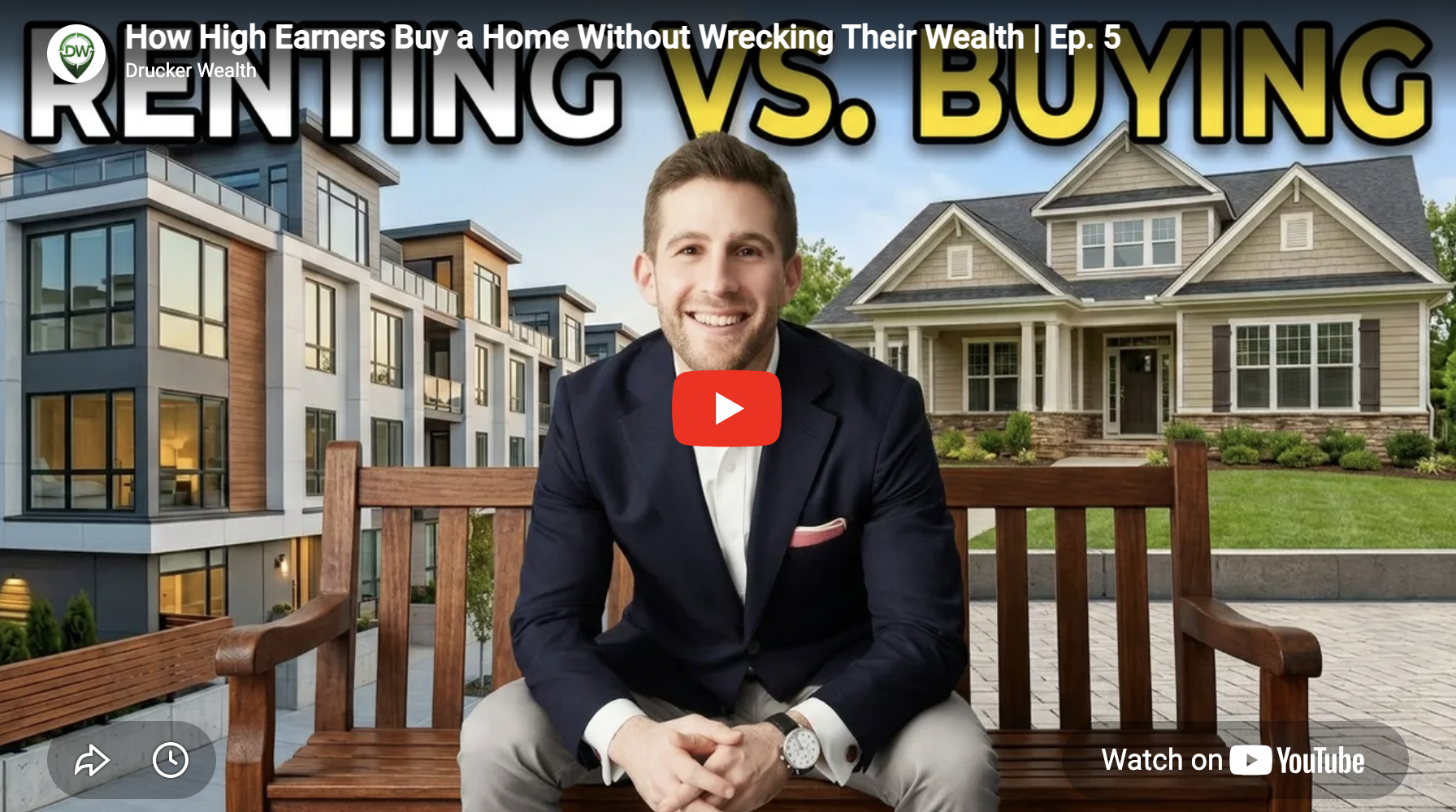
How High Earners Buy a Home Without Wrecking Their Wealth | Ep. 5
Watch the Episode
Episode Summary
Buying a home is one of the biggest financial decisions most families will ever make, but determining how much house you can afford involves far more than just the monthly mortgage payment.
In this episode of Beyond the First Million, Gideon Drucker and Jordan Haines break down the key considerations behind renting versus buying, including when renting may actually be the smarter choice and how to evaluate housing decisions through the lens of your overall financial plan.
They discuss the hidden costs of homeownership, affordability guidelines, down payment strategies, and why a primary residence should be viewed as a lifestyle decision rather than an investment.
The conversation also explores the trade-offs that come with housing decisions, the importance of flexibility, and how families can align homeownership goals with their long-term financial priorities.
Topics Covered
The Home That Got Away [00:00]
When Is the Right Time to Buy a Home? [03:24]
Why Renting Can Be the Smarter Choice [08:52]
The 20% Rule for Housing Costs [12:17]
Spending, Saving, and Taxes [15:15]
The Hidden Costs of a Bigger House [19:44]
Why a Bigger Down Payment Doesn't Make a House More Affordable [23:10]
Resources & Links
Transcript
Below is the full transcript for Episode 5 of Beyond the First Million.
The Home That Got Away [00:00]
Gideon: Welcome to Beyond the First Million by Drucker Wealth. I'm your host, Gideon Drucker, alongside my colleague Jordan Haines, and we're excited to be here.
Last week we spoke about education planning, education funding, and really all things family planning. More broadly, even generational planning. Today, I would say we're doing this entire podcast so I can tell this 30-second story. I think we'll have more episodes, but this story is really what's driving the conversation today.
Jordan: You're working through something...
Gideon: Yeah, we're working through something. That was a joke.
We will have many more episodes, although this is the center that's holding everything together today. This episode is all about home buying. My story doesn't have that much to do with the larger conversation, but we've all got stories, right? Real estate can be stressful. It's a big deal.
My wife and I are actually looking at buying a home. I think I mentioned in a previous episode that we're looking in Chappaqua, near where my sister lives. We found a home, loved it, made an offer, got the offer accepted, rushed to do the inspection, and even had our families come see it because we wanted them to be part of the process. We were moving through the contract stage as fast as possible. Then, six days after we saw the house for the very first time, we got a call from the broker saying they were still showing the property, somebody else had made a higher offer, and they had accepted it on the spot. Thanks anyway.
Meanwhile, we were already imagining how we were going to live there. We were talking about where furniture would go, how we would use different spaces, and what life would look like in the house. So yes, I'm a little scared. I definitely don't think that person is listening to this podcast, or doing much to advance good human behavior here on earth, but we'll move on.
Jordan: We're done with Beyond the First Million.
Gideon: We had a good run. Four episodes.
But seriously, this is why we're doing this episode. Today, we're going to talk about all things home buying. Everything we're discussing applies primarily to your primary residence, although many of the same principles apply to vacation homes as well. At the end of the day, buying a home is a lifestyle decision. An investment property is an investment decision. In most cases, I don't think it's a particularly great one, but we'll save that conversation for another day.
Jordan: This is a personal decision that has financial implications.
Gideon: One hundred percent. We like to say that personal finance is a lot more personal than it is finance. If there is one message or theme of this podcast, it's figuring out how to make great life decisions and then implementing them in the most financially and tax-efficient way possible. That's how we think about this.
Buying a primary home is, for most people, the single biggest financial decision they'll ever make and the largest amount of money they'll ever spend at one time. And even with all of that, I still think it's a decision that is often underappreciated, underanalyzed, or simply not considered within a wide enough context. That's really what we want to spend today talking about.
When Is the Right Time to Buy a Home? [03:24]
Gideon: So the first thing we want to talk about is when to buy a home. We'll get into how we think about price, cost, and all of that, but I think this idea of the American Dream is where most people start. They think, "I need to buy a home. I get to a certain age, a certain family status, a certain income level, and I need to become a homeowner."
I've seen so many people, and we've had clients too, who come to us and say, "Yeah, we should probably buy a home in the next 12 months." Then we start digging into it, and they're not really sure where they want to end up. They know they want to have kids, or maybe they want their kids to go to a different school in a different area. There's no real reason they need to be in a specific location or buy a home right now. It might actually make more sense for them to rent. The only reason they're considering buying is because they feel like they should.
Jordan: Would you say that sometimes it's a feeling of, "I haven't made it yet," or "I'm not a mature adult unless I own a home"? Sometimes it feels like that.
Gideon: One hundred percent. I think that's a huge driver. It's an insecurity thing, and I don't mean that in a bad way. We all look around and wonder what our neighbors are doing, what our friends are doing.
Morgan Housel talks about this a lot in The Psychology of Money. Nobody knows what's in your bank account. Nobody knows what's in your investment account. You could have $4 million sitting in your 401(k), IRA, and investment accounts, and nobody would have any idea. But if you live in a $3 million house, everybody can see that.
Now, I would argue that means you more or less don't have that $3 million anymore because you've spent it on the house, but there is definitely an emotional component to it. There is an ego component to it, and I don't mean ego in a negative way. It's visible wealth. It's wealth that people can actually see. Nobody walks around showing their bank statements to their friends. But people absolutely show off their homes. Even when my friends thought we had bought that house, they immediately wanted pictures. They were saying, "Send me photos. Let us see it." And I remember thinking, "How do I do that without just sending them the Zillow listing? Because with Zillow, you're basically sharing everything. Here are my property taxes. Here's the maintenance estimate. Here's the monthly payment. Here's the entire financial picture." There's really no other area of your financial life where that happens. They just wanted to see the house, but there was no way to do that without indirectly showing them all the numbers too.
All of this is part of the conversation. It gets to what we're really talking about today. Home buying is so much more emotional than people realize, and in many cases, people are thinking about it backward. To use my own story, I've lived in New York City for the last decade. Financially, I could have bought a place over the last several years. It never even crossed my mind because I knew I didn't want to end up there long-term. I always knew I would eventually leave. I'm not really a city person. Going to shows and concerts isn't how I spend my time.
Every year that I continued renting, I gained more clarity about my financial picture and about my life. So when I was finally ready to buy, I knew a lot more than I did years earlier. For something as simple as relationships, I was single for a lot of those years. I didn't know who I was going to end up with. Now I do.
The same thing applies to career decisions. Maybe you're starting a business. Maybe you're 30 years old and still figuring out your career trajectory. Every year that you rent, you're building your net worth, saving more money, and maintaining flexibility. Your family situation can change. Your parents can move. Your siblings can have kids. You may suddenly want to be closer to them. Your career prospects may change.
That's why I never viewed renting as throwing money away. I always say rent is typically the most you'll ever spend on housing, while a mortgage is the least you'll ever spend on housing. When you're renting, your rent is your number. You're generally not paying much beyond that. But when you buy a home, the mortgage is just the starting point. Then there are property taxes, insurance, maintenance, HOA fees, repairs, renovations, landscaping, staging, and all the other expenses that come with ownership. I've always looked at rent as the cost of having a place to live. Everything else I do financially is building toward eventually buying the right home at the right stage of life.
Jordan: In our marriage, we moved six times in six years. Every single year we moved somewhere different, and we always rented. We lived in Washington State. We lived in Utah. We moved closer to family. We had kids during that time. Through all of it, renting worked because every year we could ask ourselves, "Is this where we actually want to live?" Eventually we found a place where we said, "Yeah, this is it."
Gideon: And you said yesterday this is where you want to be for the next...
Jordan: We looked at that every day. We literally walked the neighborhood and asked ourselves, "What would it be like if our kids walked to school from here?" We spent a lot of time thinking about it before making a decision.
Eventually we found a place that we love. But along the way, I could have bought a house in any one of those places. We chose not to because we were researching, learning, and figuring out what was actually important to us. It gave us flexibility. Honestly, when I first graduated and started making money, I thought I knew what was important to us. Then we lived in the Pacific Northwest for almost a year and realized that wasn't actually what we wanted.
That's why I love talking with clients who are moving across the country or even across the state. They'll say, "I know exactly what I want." And my reaction is always, "You've lived there for two days. How could you possibly know exactly what you want?"
Why Renting Can Be the Smarter Choice [08:52]
Gideon: We talked about this before, but we work with a lot of doctors. A common situation is that they finish residency, get a new opportunity, and have to move somewhere completely different. The biggest thing is exactly what you said. If you're moving across the country, rent. Spend some time there first.
We actually had a client, a young couple, where one spouse was a doctor. They were moving from New York down to the DC-Baltimore area, and they wanted to rent. We strongly agreed with that decision. You don't know what you don't know until you get there. You need to live somewhere every day. Go to the local stores. Learn the commute. Become part of the community. Figure out whether this is actually where you want to spend the next 10, 15, or 20 years.
The idea of somebody moving across the country and saying, "We're going to rent for a month and then buy a house," just doesn't make much sense to me. Give it a year. Figure out what you want from the location. If for no other reason, you're simply going to make a better housing decision once you understand the different neighborhoods and areas.
As I'm looking at homes in Westchester right now, if I weren't from this area, I would have no idea about the nuances between different towns, different school districts, or even different parts of the same town. It's not that one is better than another. It depends entirely on what you're looking for. Personally, I'm looking for houses within about a four-minute radius of where my sister, her husband, and their kids live. My wife would probably be okay with 10 to 15 minutes. We'll meet somewhere in the middle, as they say.
The point is, you need time to figure those things out. And while you're renting, give yourself permission to spend a little more if it helps you learn what you want. When I was talking with that client moving to the DC-Baltimore area, they had just had a child. We were discussing rent, and I think the number was around $8,000 to $9,000 per month. They weren't the type of people who spent freely. They were used to paying closer to $5,000 or $6,000, and even getting them comfortable with the higher number took some discussion. I remember saying, "Guys, this is one year. You have a newborn. You're making great money. You're in fantastic financial shape. And quite frankly, you're moving to a lower-cost area than New York City." You can afford to spend a little more during a temporary period while you're figuring out the next stage of your life.
I don't even think of it as taking a risk. It's giving yourself permission to learn. You may not be comfortable committing to a 30-year mortgage today, but you can absolutely spend a year or two figuring out where you want to be, what kind of community you want to live in, and how all the pieces fit together. That's why, when you're moving somewhere new, give yourself time. Give yourself permission to figure it out. You do not need to buy immediately. And now you're in your forever home.
Jordan: I know. It's great. I think the general principle is that renting provides flexibility, both financially and personally. It gives you the opportunity to learn the area, understand the commute, get involved in the community, and figure out what matters to you before making a long-term commitment.
And the nice thing is that it's relatively low risk because you can always move. You're not locked into anything. What we'll talk about later in this conversation is why buying a home isn't nearly as flexible as people think. There are a lot of downstream effects from this personal decision that people don't always consider.
Gideon: Exactly. We'll get into that because there are a lot of costs and considerations that come with homeownership that people don't always think about. I've alluded to it already, but there's a lot more going on when you buy than when you rent.
And to be clear, most of our clients are homeowners. Many of them already own homes when they come to us. Others are buying larger homes as their families grow, purchasing vacation homes, or relocating entirely. Almost all of our clients eventually become homeowners. So none of this is an argument against buying a home.
The point is simply this: don't let people outside of your family dictate when you buy. Don't let social pressure determine the timing. Buy when it makes sense for you, your family, and your goals. Do it on your own timeline and at your own pace.
The 20% Rule for Housing Costs [12:17]
Gideon: Then, when it is time to buy, which is really what we want to talk about next, we can get into how to think about price and cost. We're going to start with two rules of thumb because I think they'll help inform the conversation and give people some simple back-of-the-napkin math.
The first rule is that we generally don't want our clients spending more than 20% of their gross household income on housing costs. So, keeping the math simple, if your household makes $500,000 a year, we don't want more than $100,000 of that income going toward housing. And when we say housing costs, we're talking about all of it. Mortgage principal and interest, property taxes, condo or HOA fees, homeowners insurance, and maintenance costs. Maintenance is one of those categories people tend to underestimate. It includes fixing things that break, but it also includes furnishing a home, landscaping, maintaining a pool, and all the other expenses that come with owning a property.
When we're helping clients forecast a home purchase, we typically use 1% to 2% of the purchase price as an estimated annual maintenance cost. So if you're buying a $2 million home, we want to build at least $20,000 per year into the plan for maintenance and upkeep. Some years it will be more. Some years it may be less. But on average, things happen, and we'd rather be conservative when we're planning. You'll find other rules out there. Some people use 25% or even 28% of gross income for housing. We've simply found that staying closer to 20% is one of the surest ways to make sure people remain comfortable financially and don't become house poor.
The last thing you want is to buy the house you've always dreamed about and then find yourself feeling tighter and tighter every month. At that point, it starts taking away from the enjoyment of the home itself. You might say, "This is my dream house. I've always wanted this." But it's going to feel a lot less like a dream house if every time you look at it, you're also thinking about the financial stress it's creating. It's very difficult to separate those two things. If you're stretching too far financially, eventually the house becomes associated with anxiety instead of excitement.
The second rule of thumb is broader than just housing, but it's one we use all the time. We want our clients saving at least 20% of their gross income. There are situations where we may want that number to be higher. Maybe somebody wants to retire early. Maybe they're planning to go from two incomes to one. Maybe they have a very specific goal they're working toward. But as a baseline, we want at least 20% of gross income being saved. Again, if you're earning $500,000 a year, we'd like to see roughly $100,000 being saved annually.
Now, where that money goes isn't really the important part of this conversation. It might be going into investment accounts, retirement accounts, 529 plans, bank accounts, or high-yield savings accounts. The vehicle matters less than the behavior. What matters is that the money is being set aside for the future. And that's an important distinction because when we talk about saving, we mean saving for an undetermined future goal.
If you tell me, "I'm putting away $30,000 because we're installing a pool in eight months," that's great. It sounds fun. But that's not really saving. You're not preserving that money for the future. You're simply delaying the spending. When we talk about saving, we're talking about setting money aside because we know we want more options, more flexibility, and more resources in the future than we have today. That's really the purpose of saving. It's money being preserved for a future goal that may not even be fully defined yet.
Spending, Saving, and Taxes [15:15]
Jordan: Yeah, zooming out a little bit, I was explaining this to a client recently. We were talking about keeping housing expenses around 20% of income, and they asked, "Why?"
I think part of the answer is what you just explained. If you simplify where your money goes every year, it really ends up in a few buckets. You make money, and then that money either goes to taxes, housing, spending, or saving. Those are the major categories. So when you spend more in one area, you naturally have less available for the others. That's why we like the 20% housing guideline. It allows room for a healthy savings rate as well. If we're also saving around 20% of gross income, that's usually a very strong foundation and helps make work optional in the future.
This isn't about some magic number where everything falls apart if you're slightly above or below 20%. It's really about creating balance.
Gideon: Exactly. And what you said is really important because there's a reason we're talking about percentages and not dollar amounts. This isn't a judgment thing.
If you make $10 million a year and want to buy a $20 million home that costs you $1 million a year to maintain, okay. The numbers don't really matter for the point we're making. This isn't about saying nobody should spend a certain amount on housing or that there's a limit on what kind of house someone should own. Buy whatever floats your boat, as long as it fits within the plan.
The reason we use percentages is because every percentage has to add up to 100%. If you're spending 20% on housing, and taxes are going to take another 30% to 40%, especially in places like New York City or San Francisco, then the question becomes: how much is left for everything else?
That's really the point. We're not saying there's a cap on housing spending. We're saying there is a relationship between housing and every other place your money can go. You've said this to me a few times, and it's so simple that it's stuck in my head. There really aren't that many things you can do with money. You can spend it, save it, or pay taxes on it. We carve housing out separately because it's such a major conversation point for our clients, but if you zoom out, that's really it. Spend it, save it, or pay taxes on it.
The more you do of one, the less there is available for the others. You can even think about saving a different way. Instead of calling it saving, think of it as future spending. You have current spending, future spending, and taxes. The money you're saving today is eventually going to become spending later. We're not saving money for the sake of saving money. When we talk about a 20% savings rate, what we're really saying is that someday you're going to take all of that money you've saved, invested, and compounded, and use it to support your lifestyle when you retire or decide to slow down.
So the goal isn't to accumulate money forever. The goal is to create future options. I know we're drifting a little from the housing conversation, but sometimes it's helpful to zoom out and simplify things. You do this really well with clients. We'll be deep in the weeds talking about account types, tax strategies, and fifteen different recommendations, and you'll stop the conversation and say, "Guys, there are really only two decisions here. We either need to spend a little less or save a little more. Everything else takes care of itself."
Then the question becomes: where is that money going to come from? It's almost like shock therapy. Sometimes people get so wrapped up in complexity that they stop seeing the obvious answer right in front of them. You simplify it down to the core decision, and suddenly it's clear.
There have definitely been times in my life where somebody essentially says, "You have four options. What are you going to do?" And whatever immediately comes to mind is probably the thing you already knew you wanted to do. So again, spend it, save it, or pay taxes on it. That's really why we use both percentages.
And bringing it back to housing, we've had clients, especially in New York City, where the transition from renting to buying doesn't actually create a huge increase in housing costs. Sometimes they're already paying extremely high rent. We've also had clients where they're looking at buying a home that is completely reasonable. It's under 20% of their income. On paper, the house isn't the problem at all.
The challenge is that they spend so much money in every other area of life that even a relatively small increase in housing costs can break the plan. Maybe they're going from $8,000 a month in housing costs to $10,000 a month. That's not a dramatic difference. But if they're already spending $20,000 a month on discretionary expenses, suddenly that extra $2,000 becomes a real issue.
What we've explained to clients in situations like that is that they're taking what was previously a strength of their financial plan and turning it into something average. Their lower housing costs were the reason they were able to save 20% of their income. That was the strength. If they increase housing costs, even modestly, without changing anything else, the plan stops working because every other area of spending is already stretched relative to their income. That's why all of these decisions are connected. I keep coming back to the same answer, which is, "It depends." Buying a house depends on every other way you spend money. It depends on what's important to you. It depends on your priorities, your goals, and the trade-offs you're willing to make. That's why housing is never really just a housing decision.
The Hidden Costs of a Bigger House [19:44]
Jordan: They're trade-offs. You made a comment earlier, and I want to spend a little time on it. If we were making a bullet-point list of all the additional costs that come with buying a home, I think that's where a lot of people get surprised. People come to us and say, "I want to buy a house. What's the mortgage payment going to be?" And it's like, great, that's one part of the equation. You're not simply replacing rent with a mortgage. You're replacing rent with a mortgage and a whole list of other expenses.
Gideon: Or they want to put more money down, which is the second conversation we hear all the time. Actually, we had a client just a couple of weeks ago. They've been a client for a long time, they recently had another child, and they wanted a little more space. They already lived in a home worth a little over $2 million, and they were looking at moving into something closer to $3 million. I use those numbers not because the exact numbers matter, but because they provide context for the type of decision we're talking about.
When we first ran the scenario and showed them the impact, what surprised them wasn't necessarily the purchase price. It was everything else. The property taxes, the maintenance costs, the insurance, all of the additional expenses that came along with the larger home. The impact on their financial plan was much greater than they expected when they were simply thinking, "We're moving from a $2 million house to a $3 million house."
That's a really important point. When you buy a bigger home, every part of that home becomes more expensive to maintain. We talk a lot about compounding in a positive direction, but compounding works the other way too. When you're spending more, everything compounds against you. Going from a $2 million home to a $3 million home doesn't just increase one number. Your interest payments increase. Your property taxes increase. Your maintenance costs increase. Your insurance costs increase. One column changes, and suddenly nine other columns become more expensive too.
And especially today, interest rates matter. Maybe they bought their first house five or seven years ago with a 3% mortgage rate. Now they're looking at rates closer to 5.5% or 6%. The mortgage interest alone can completely change the economics of the decision. In some cases, it can feel like you're buying a house twice as expensive as the one you originally purchased.
All of those things come together. I think sometimes people fall in love with a house and all they see is the purchase price. "I love the house, and that's what matters." But then you have to start pulling on all the other threads. You want a pool? Great. Now you have to maintain the pool. Who's cleaning it every week? Are you doing it yourself? If so, how much is your time worth? And at what point are you going to decide that you're not actually a professional pool cleaner and you'd rather hire somebody?
Now there's another recurring expense. You want a large property? Great. How are you maintaining that land? You want to live farther away from your kids' school? Okay. Who's driving them every day? Do you have a nanny? Are both parents working? Is one parent staying home? Every housing decision creates a series of downstream decisions.
A lot of our job is simply asking those questions. Sometimes clients haven't thought through all of them yet. We bring them up, and then after the meeting they're going to have the real family conversation about what those decisions mean and how they impact their lives.
Why a Bigger Down Payment Doesn't Make a House More Affordable [23:10]
Jordan: Let me ask you a question because I think you hear this all the time.
Most people understand that if they put more money down on a house, they'll have a lower monthly payment. So if I hear everything you just said and respond, "Okay, then what if I just put more money down?" what effect does that have?
Gideon: We hear that all the time. And it's interesting because we work with very smart, financially savvy people. But there's definitely an emotional component to this conversation.
Let's say Gideon tells you that the house you're looking at is a little above your budget and may stretch the plan. The response is often, "Well, what if instead of putting 20% down, I put down a million dollars? Then my mortgage payment goes down, my monthly costs go down, and everything works."
What I always tell people is that this is really an investment conversation, not an affordability conversation. Maybe putting more money down is the right move. Maybe it isn't. That depends on interest rates, investment opportunities, cash reserves, and a lot of other factors. But it has absolutely no impact on whether you can afford the house in the first place.
All you're doing is moving money from one place to another. Yes, your monthly payment goes down. But the reason it goes down is because you're taking money out of your net worth and putting it into the house. That money was previously invested. It was growing. It was compounding. It was liquid. Now it's sitting inside a house.
Sometimes I'll show clients exactly what that means. I'll say, "Your net worth is currently $3 million. If you put an extra million dollars into the house, your investable net worth drops dramatically overnight. Yes, your monthly expenses go down, but the only reason we cared about lowering those expenses was because we wanted more money available for saving and investing. We just gave up a huge portion of that in one move."
It's not necessarily a bad decision. It may be right depending on the situation. But a lot of times it's an emotional way of making yourself feel better about buying a house that's pushing the limits of your budget. It's really just moving money from one pocket to another.
Jordan: Yeah, and it goes back to the conversation we had earlier. If more of your income goes toward housing, then less goes toward saving. That's the trade-off. Well, if you increase your down payment, the trade-off changes. Instead of reducing your future savings, you're reducing your current investments and liquidity. Either way, something is being given up. And sometimes that's okay. Sometimes that's exactly what we want to do. But there's always a trade-off.
The second thing that came to mind while you were talking is that we've said buying a home is a personal decision with financial implications. Once you start pulling money out of your investments to support the purchase, you're taking resources that were intended for the future and moving them into a decision you're making today. And frankly, I don't think most people buy a house thinking, "Thirty years from now I'm going to sell this and use the profit to fund retirement."
Gideon: One hundred percent. Your primary residence is a place to live. Can you make money on it? Absolutely. But I think people often look at their primary residence and say, "It was the best investment I ever made." Usually it wasn't. What happened is they bought the house, lived in it for 30 years, never looked at the performance, never calculated the returns, and then one day they sold it for a much larger number. They say, "I bought it for a million and sold it for three million." Sure. But that happened over 30 years.
If people treated their investment accounts the same way, putting money in, ignoring it, and letting it compound for 30 years, the numbers would also be enormous. A primary residence is a place to live first and foremost. If you make money when you sell it someday, great. That's a benefit. But it's not the reason to buy it. And even then, people say, "I'll sell it and keep the profit." Okay, then what? Now you need another place to live. Maybe you'll downsize, but honestly, I rarely see people intentionally and proactively downsize. Most people take whatever profit they made on the previous house and roll it into the next house.
So that money stays tied up in their primary residence for most of their lives. Again, we're not saying don't buy a home. When I think about the house I grew up in, my parents lived there for 30 years. My dad would tell you it was one of the best investments he ever made because that's where he raised his family. It was the house all the kids wanted to come to. It was full of life, memories, and experiences.
It was a great place to live. But that's very different from saying it was an incredible financial investment. If it turns out to be both, that's great. But that's not the reason we do it. This is probably one of the most common questions we hear: "What if I just put more down?" The reason people ask is because they want lower monthly housing costs. And for the clients we work with, lower housing costs usually means they want to save more money. They'll say, "If I spend less on housing, I can hit the 20% savings goal you've been talking about." That's true. But the only reason we care about the 20% savings goal is because we're trying to build net worth. If we dramatically reduce net worth upfront in order to hit the savings goal, we're working against ourselves. That's why this conversation is so important.
Jordan: I think that's really the theme of everything we've talked about today. Trade-offs. Everything has trade-offs. If you increase the amount you're spending on housing, you're taking away from your ability to save. If you increase your down payment, you're probably taking away from your investments or your liquidity. That's not necessarily bad. We want people to buy homes. It's wonderful when they do it the right way.
We just want them to buy at the right time, with their eyes wide open, and fully understanding the trade-offs they're making. I think that's really what today's conversation has been about.
Gideon: Absolutely. I think that does it for us today. We will see you next Thursday. Thank you for being here with us. As always, if you have questions, comments, or ideas for future episodes, leave them below and we'll be sure to take a look. Thank you, and we'll speak soon.
