
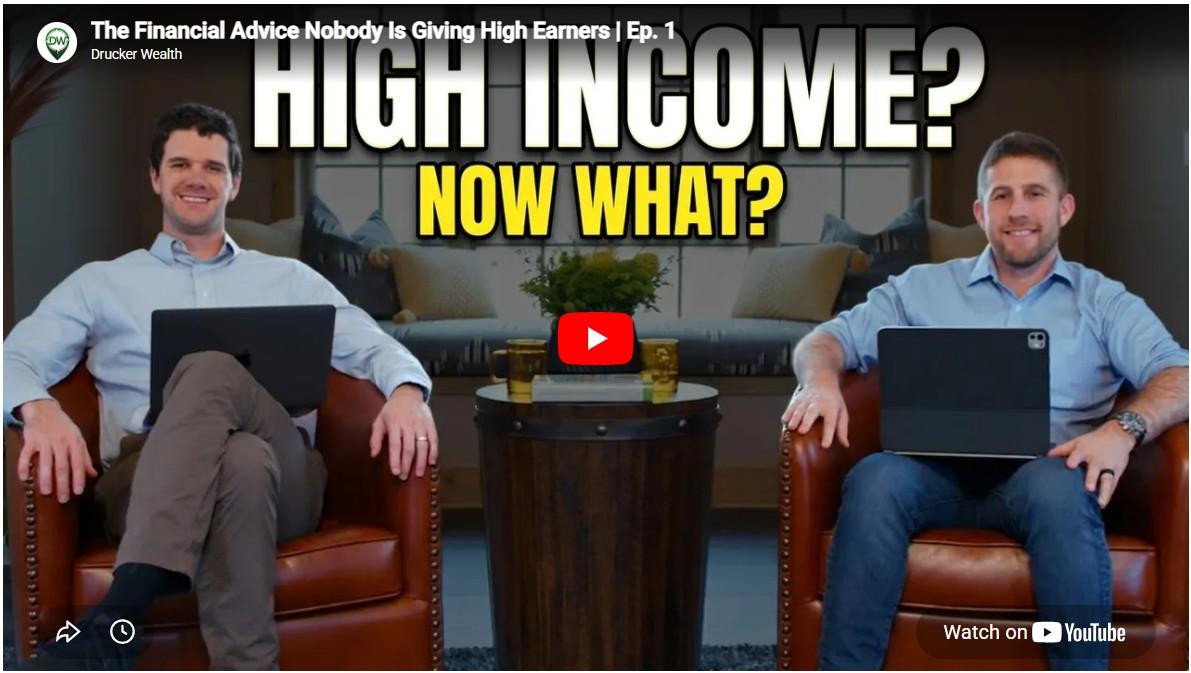
The Financial Advice Nobody is Giving High Earners | Ep. 1
Watch the Episode
Episode Summary
In the first episode of Beyond the First Million, Gideon Drucker and Jordan Haines explore why many high earners spend too much time optimizing minor financial decisions while ignoring the handful of choices that actually move the needle.
They discuss spending, retirement, housing decisions, lifestyle creep, and the emotional side of money once basic financial success is already established.
The conversation focuses less on market commentary and more on how mid-career professionals can think more intentionally about building a financial life they actually want.
Topics Covered
Why Optimization Culture Misses the Point [00:00]
The Financial Decisions That Actually Matter [04:30]
Why a Dangerous Amount of Money Creates More Decisions [09:55]
Spending More Intentionally [14:35]
Lifestyle Creep vs Lifestyle Design [19:30]
What High Earners Get Wrong About Retirement [23:55]
Building a Financial Life Beyond Accumulation [26:26]
Resources & Links
Transcript
Below is the full transcript for Episode 1 of Beyond the First Million.
Why Optimization Culture Misses the Point [00:00]
Gideon: Welcome to Beyond the First Million by Drucker Wealth. I'm Gideon Drucker, and the much taller gentleman to my right here is Jordan Haines.
Jordan: I'm slouching...
Gideon: We are both lead planners at Drucker Wealth, an independent virtual RIA that works with high-income earners and their families all around the country. This podcast, which is somewhere between two and 40 years in the making, is about the real-life financial decisions that high-income-earning families make every day from the point of view of two people guiding folks through those very decisions.
We'll tackle how our clients think about home buying and education planning, how they balance retirement savings and vacation spending, and every little financial decision they make along the way. No hot stock picks, no market-timing strategies, and definitely no secret/illegal tax loopholes here.
We want this to be about what happens in the lives of our clients day to day. We'll focus relentlessly on how to use your money to optimize your life in the real world. We'll also give you a peek behind the scenes of what a financial planner actually does and what matters if you're considering hiring one. That's the promise: real-life considerations, real client stories, and real advice to help you make better financial decisions.
New episodes will post every Thursday. We can't wait for you to join us.
All right, our first episode. How are we feeling?
Jordan: Great.
Gideon: You got in, and your flight was delayed until 2 AM... and you're feeling good and relaxed.
Jordan: Yeah, I got to fly in from Boise, which means I have to stop everywhere in between here, but it's great.
Gideon: I only had to drive an hour, but that is probably a good introduction to who we really are. I am a Type A New Yorker, and you are a lot more chill, a lot more relaxed.
Jordan: What do they call that, Type B? That's what it's called.
Gideon: Just to start, we can explain a little bit about how we got together, and then we'll talk about why we're doing this podcast and who it's for. I'll introduce you a little bit and explain how we got to know each other.
I think we met about two years ago.
Jordan: Has it been that long ago...
Gideon: Time flies when you're having fun.
Around two years ago, you were with another firm, actually a fintech firm, and Drucker Wealth can be pretty intense when we're dealing with vendors, partners, and people trying to sell us things. We take what we do with clients very seriously. We ask a lot of questions, we're intense, and you came in and kind of wowed everybody on the Drucker Wealth team.
We vaguely stayed in touch while you were doing your thing, and then when the opportunity came up where we were looking for another lead planner and you were looking for a new role, it was a match made in heaven. At least from our perspective, that's your journey to Drucker Wealth. You started about six months ago.
Jordan: Yeah, something like that. And here we are now.
Gideon: I think that's pretty cool for the podcast too because we have a lot of similar ways of thinking about financial planning and working with clients. I don't think this would really work if we didn't. At the same time, we've had totally different experiences over the last 10 years, and you've come into Drucker Wealth over the last six months asking, "Alright, how do we do everything? What do you like? What would you change?"
Jordan: I'm still learning the Drucker Wealth way. I actually think this is going to work out great because we've both done financial advice and planning for all sorts of different clients. A lot of the things we're going to talk about, things you've written about in your book, are things I'm learning for the first time. I'm going to ask a lot of questions because I'm learning alongside a lot of the listeners and people watching this, too.
Gideon: It's been interesting to see, over the last six months, what has been obvious to both of us that we're completely on the same page about. That's probably 80% to 90% of it, and those are usually the things that matter most. The areas where we think a little differently are more on the margins, and honestly, that's fun to talk about too.
We're going to start with why we're doing this podcast. My favorite question that we ask prospective clients is: Why now? A lot of people have been thinking about something for 10 years, and then all of a sudden it's, "Oh my God, I need a financial plan by next Wednesday." That's a little bit how I feel about this podcast.
I've been thinking about doing a podcast for years. I've been told we need to do a podcast for years. There are two reasons we're doing it now. The first is simple: it was never at the top of the priority list. We've had a lot going on as a firm. We've been growing, hiring, and meeting great people. It just never rose to the top of the list of things we needed to do immediately.
The Financial Decisions That Actually Matter [04:30]
The second reason... and I'm saying this early to put a little less pressure on myself is that I'm a perfectionist. I'm a writer at heart. I like looking at a paragraph and spending hours fine-tuning every word. Even while I'm speaking right now, part of me wants to go back and redo everything we just said. But we're going to keep rolling and get comfortable with that.
Jordan: How long have we have you been thinking about doing a podcast? Be real...
Gideon: Three years. Probably a full year of saying, "We should be doing this next week," and then something comes up and we don't do it. I think back to when I first started. Bridget, who's sitting off camera right now, and I would record videos. It might be a one-minute explanation of a Backdoor Roth, something I've explained to clients thousands of times, and it would take us nine hours to create that one-minute video. One word could always be better. That's just how I'm wired.
We're going to get away from that because there's a lot of overlap between that mindset and financial planning. Perfect is the enemy of good. People say, "I can't do a financial plan because I don't know what my income will be in seven years," or "I don't know what college my kids are going to attend in 12 years." You're right. You're never going to know those things. But that doesn't mean you can't do things today that put you in a better position tomorrow.
So we're going to drink our own Kool-Aid, if that's the expression, and keep this moving... You've been on a podcast, you've done this before, maybe just share a minute of your background, and your way to Drucker Wealth.
Jordan: We are so different in so many ways. I think that's been one of the best parts, honestly, in a lot of good ways. We first met two years ago. I was a vendor at the time, consulting other financial advisors on how to do things and talk to clients in a new way, and I was really impressed with the firm and the things you were working on. Honestly, the stars aligned when we talked six months ago and I joined the team, so it's been fun.
What's been really fun has been learning how different we are. You wrote two books. I've started podcasts before I'll ever write a book. I like flying by the seat of my pants a little bit. But I think that goes to our philosophy when it comes to working with clients, which we'll talk about and share plenty of stories about. Working with people who are actively building wealth, saving, earning money, growing their families, and going through all these life changes, you have to focus on the things you can control. Sometimes life is flying by the seat of your pants.
Gideon: And adjusting in real time. Even the way we communicate in Slack is a good example. You'll send me a 10-minute voice note, and I'll respond with paragraphs of written content. Then you'll send me another voice note.
Jordan: Last week he finally said to me, "Please stop sending me these long videos. Just write it up. And I was like, "Okay, that's fine, we could do that."
Gideon: Everybody communicates differently. We'll talk about some of that in terms of what we do with clients, but I think the most important thing is figuring out what's actually going to move the needle forward. What do you need to do to get someone to take action? So the second part of why we're doing this podcast now is that, despite there being 8,000 podcasts out there, I really haven't heard many financial-planning-oriented podcasts that focus on major life decisions. This isn't about how to file taxes, how to do a Backdoor Roth, or how to tax-loss harvest your investments. We might allude to those things in client stories, but this is really about the financial decisions families make every day.
We know from working with hundreds of clients that people don't share these decisions with their friends. They'll show their friends the new house they bought, but they're not explaining, "We bought this house because it's under 20% of our gross income," or, "We structured it this way because it fit our plan." Nobody is talking about how they're thinking through college planning, retirement decisions, or balancing competing priorities. Everybody kind of just knows what they do, even with their closest friends.
If we can unpack that a little bit and help people understand what we see every single day with the clients we're working with—what they're thinking about in terms of retirement, travel, family plans, and major life decisions—and do it through real client stories, that felt like something that was missing. That's something we can provide.
Jordan: Whenever somebody asks what I do for a living and I say financial advice or financial planning, I still don't really know what to say. I haven't figured out the perfect way to describe it. But whenever I explain it, people immediately want to talk about real estate strategy, investments, security selection, markets, and all the things that are easier to talk about. They're asking, "What should I do here?" And my response is usually, "Let's sit down for three hours and talk about what's most important to you first, so I can help you understand what you should do."
Gideon: They're like, "I really just wanted the tax strategy."
Jordan: Exactly. It's not as fun to talk about out loud for a lot of people because we're not walking around having conversations about what matters most to us. Even for those of us who are married or in close relationships, it's hard to talk about. These aren't normal conversations.
Gideon: I know you're married and have three kids, and I don't think at the end of the day you and your wife are sitting down asking, "What are our financial values? How do we think about money?" You're busy. You're hanging out with your kids. You're getting them to sleep.
Jordan: I'm the financial advisor, and I don't think we've ever had that conversation.
Gideon: Right. And that drives everything. We'll get into all of that, but if you're not having those conversations with your spouse, your parents, or your loved ones, you're probably not having them with anybody else either.
So let's spend a little more time talking about who this podcast is for. We've alluded to it a little bit, but I think it's helpful to be direct on that point.
Why a Dangerous Amount of Money Creates More Decisions [09:55]
Jordan: I want you to explain something because I think this will lead nicely into the next topic. I was reading your book the other day, and this is something that's newer to me. Frankly, I haven't heard this phrase used very often, and I consume a lot of financial media. You've used the phrase a dangerous amount of money to describe the situation a lot of our clients are in. I think that would be interesting to explain because it might help define exactly who we're talking about.
Gideon: Yeah, absolutely. I'll get into what I mean by a dangerous amount of money, but first I'd say we define a great client for us more by household income than net worth, which is a little different from the traditional wealth management world. We work with high-income-earning families and career professionals, typically people in their 30s and 40s. I think our average client age right now is 43.
And again, this whole podcast is not a pitch for Drucker Wealth. But if we're sharing client stories, I think it's important for listeners to understand who we're talking about and how closely that aligns with their own situation. Typically, we're talking about households in their mid-40s making somewhere between $300,000 and $1 million a year. I realize that's an incredibly wide range, and where you live obviously matters. That's something we'll probably talk about in future episodes.
But the people we're working with, and the people this podcast is really meant for, are those who feel completely comfortable with their day-to-day income. That's where the dangerous part comes in. Somebody who isn't making that kind of money might hear me say that and think, "Really? You help people making $500,000 a year? How much planning do they actually need?"
The answer is a lot.
If you're making that kind of money, let's call it $500,000 or $600,000 a year, you can fund most of the things you want to do. Family plans, summer camps, tennis lessons, dinners out, concerts. You're not thinking twice about those expenses. But you're also not making so much money that you can say, "To heck with it. We can do whatever we want. We'll retire whenever we want. We don't need to think about the future."
You do need a plan. That's very different from somebody making $5 million or $10 million a year. As long as they're not completely off their rocker and doing ridiculous things, they're probably going to be okay.
The dangerous amount of money is when you're comfortable in the short term but still need a plan in the long term. It can be difficult to wrap your head around that idea because, to your earlier point, who really sits around talking about their financial values and future decisions? If you're making enough money to comfortably live for today and tomorrow, it can be tough to say, "Actually, we need to think about ten or twenty years from now too."
That's really who we want to guide. It's about the financial decisions and life decisions that come with being in that position.
Jordan: I'm curious what you think about this because, with clients I've worked with in the past who fit that description, there are two common themes that come up. They might not use these exact words, which is why I'm curious about your take, but sometimes it feels like they're dealing with decision overload. There are more decisions to make, and those decisions tend to have a much bigger impact on their lives. Does that resonate with this group?
Gideon: Yeah, absolutely. The 80/20 rule applies to almost everything. Eighty percent of the outcomes usually come from twenty percent of the decisions. I think that's absolutely true in financial planning.
People naturally want to focus on the smaller decisions. How do we optimize the 401(k)? How do we lower our budget for weekly dinners? How do we tweak this or that? And those things aren't unimportant. Tactical decisions absolutely matter.
But if your property taxes are way too high for your income, it almost doesn't matter how much energy you're spending optimizing every tiny detail. We'll talk about this more in future episodes, but the big decisions drive the outcomes. The challenge is that it's easier to focus on the small decisions because they're easier to change.
It's easy to say, "Let's cut back on dinners out." It's much harder to say, "We're not going to buy the $3 million dream house we've been thinking about for the last five years." People don't want to entertain that idea.
A huge part of our conversations is helping people identify the big decisions that are actually going to allow them to do the things they want to do. Usually that's education planning, home purchases, travel, career decisions, and the major life choices that have a much bigger impact than most people realize.
Jordan: I think that's a good start. What I'm hearing is that the short-term decisions, the smaller-impact decisions, tend to be more front and center. Those are the things people naturally focus on. But the bigger decisions are the ones that actually move the needle. It's not necessarily saving five dollars here and there by skipping a cup of coffee. It's the major decisions that shape the direction of your life.
Spending More Intentionally [14:35]
Gideon: Yeah, and I'm actually going to look at my notes here because I don't want to get this one messed up. This podcast, and what we do every day, is about using your money to maximize your life, not the other way around. We're not talking about what looks best on a spreadsheet. We're talking about how real people think through these decisions and what actually improves their lives.
One of my favorite examples is a client we've worked with for more than five years. They're incredibly organized and disciplined. They have a spreadsheet for everything, and we go back and forth on it all the time. I remember one meeting when they brought up something they'd been thinking about for years. Their kids were five and eight at the time, and they said, "We've been thinking about putting in a pool. We know it might not be the most optimized decision from a cash flow or savings standpoint, but we want to be the house all of our kids' friends come to. We want to be those parents, and we want our kids to have that experience. What do you think?"
My response was, "What do I think? I think that's one of the greatest returns on investment I can imagine for a family thinking about their financial goals." Beyond the fact that it worked in their plan and made financial sense, even if it hadn't been the absolute optimal financial decision, my reaction would have been, "Okay, let's figure out what else we can cut back on, change, or modify." Something that provides that much happiness and quality of life is exactly what money is for. It was one of the easiest questions I've ever been asked. And this was coming from a very analytical family. They wanted to make sure they were making the right decision, but I was excited they even asked the question because that's what building wealth is supposed to be about.
Why are we building wealth if not to spend that kind of time with our families and our kids? It took time for them to get there. I don't think in year one they would have even considered it because they were still asking, "Can we afford this? Does the plan work? What if something changes?" Over time, they became confident enough in everything else they were doing that they could start asking a different question: "Now that we've taken care of the basics, what is actually going to improve our quality of life?"
Jordan: Totally. The house we're in right now, we've been there for about four years. We bought it in an area we had scouted out for years. We knew we wanted to end up there. Honestly, if I went to most advisors and asked, "Is this a financially smart decision?" and they looked at it purely through the lens of spreadsheets and analysis, a lot of them would probably say, "No, you shouldn't do that."
I don't regret it at all. It's not like I was throwing my finances away or ruining my future. It was simply the right decision for us because of what was important to us.
Gideon: And just to jump in here, because knowing you, you're not a big spender. I think that's an important point. It's not that we're saying everybody should do whatever they want all the time. It's that this was the thing that mattered most to you.
Jordan: We don't travel. We're homebodies. One hundred percent.
Gideon: Exactly. And that's where people get into trouble. They say, "I want this house, I want to travel extensively, and we're going to go from two incomes to one income," all at the same time. That's where we have to do our job and ask, "What's most important?"
I don't want to spoil future episodes because we're going to spend a lot of time talking about priorities, risk, and goals. But part of our job is helping people identify the things that matter most and making sure the rest of the plan supports them.
It's also important to understand that our job isn't to judge. When I share client stories, people naturally relate to some more than others. The pool example is almost a little corny because most people hear it and think, "Of course, that makes sense."
But we've had clients where the thing they cared about was spending $20,000 to $30,000 a year hosting dinner parties for their friends. They lived in Los Angeles, they loved entertaining, and they wanted to make it easy for the people in their lives to get together. Some people might hear that and think it's excessive. They might not immediately understand it the way they understand a family pool. But that's what mattered to them. They were willing to make other trade-offs to support that priority, and that's completely fine.
Everybody spends money differently. I always use myself as an example. I recently got back into tennis, both playing and watching it. Living in New York City, finding court time is outrageously expensive. Every week I take a lesson with a pro, which is really just us playing sets. At 34 years old, I don't know that I actually need tennis lessons. I'm not exactly training for Wimbledon. I just wanted to play tennis and have fun.
Of course, I did the math in my head. I was calculating how much I was paying for every minute I was on the court. But when I looked back on it, it was the best hour of my week. I looked forward to it every single week. Honestly, I would have paid double because of how much happiness it brought me. It was something I genuinely enjoyed and looked forward to. And every now and then I even beat the pro. I'm not going to call him out by name because I don't think he's listening to this podcast, but it does happen. For some people it's dinner parties. For me it was tennis. The point is figuring out what's important to you and being intentional about spending money on those things. That's really what we want to talk about here.
Lifestyle Creep vs Lifestyle Design [19:30]
Gideon: That kind of leads in, and I know we both love this visual. It's in my book, and we're going to put it on the screen wherever we're posting this, whether that's YouTube or somewhere else.
Carl Richards, who was gracious enough to allow us to use his visuals, wrote and illustrated for The New York Times for a long time. He created some incredible graphics and sketches, but my all-time favorite visual, which I talk about with almost everybody, is really the core of this podcast and a lot of what we're going to discuss. The idea is that we all have four sources of capital: money, time, energy, and attention. I think a lot of planners, investment advisors, money managers, whatever you want to call us, and honestly a lot of people in general, think about wealth only in terms of dollars. How much is your net worth? What's on your statement? How much money do you have?
But the way we want to think about wealth is broader than that. How much time are you spending on things? Are you spending hours looking at your 401(k) statements when you could be hosting a dinner party, spending time with your children, or doing something else that matters more to you? How are you using your energy and attention?
Carl put it in a way that really resonated with me. Money is the only one of those four things that is potentially infinite. You can always make more money. The sky is the limit. But every single one of us has a finite amount of time, energy, and attention.
One client story always stands out when I think about this. We had a doctor client who was in fantastic shape financially. He had done a great job saving, investing, implementing tax strategies, and really checking all the boxes. We got to a point where, very infrequently, we get to tell someone, "You can do everything you've ever wanted to do without making any major changes." Usually there's some trade-off, some prioritization, or some adjustment we need to discuss. In one meeting he asked, "I've been doing a lot of research on rebalancing drift strategies. How often should I rebalance? Should I do it quarterly? Should I do it based on market movements?" He was sending me academic research and studies on the topic. At the next meeting I said, "I'm going to answer your question because there are answers to it. There are opinions on how often you should rebalance. But the most important thing I could possibly tell you is this: if I were you, I would never read academic research about rebalancing again for the rest of my life."
You have two kids. You work 70 hours a week as a doctor. Your financial plan is going to be successful whether you rebalance fifteen times a year or once. You have more money than time, and in your situation you're probably always going to have more money than time. Now, I understand that's not true for everyone. If your income isn't at a certain level yet, then yes, you need to focus on growing your income and building savings. You need to trade your time for money. But in his case, that wasn't the issue anymore.
Jordan: Everything has trade-offs.
Gideon: Exactly. My reaction was, "Go take your dad to a ball game. Go travel. Go spend time doing things you care about."
Jordan: You went to school to become a doctor, and you love your family. Go spend time with them. We'll handle the finance stuff.
Gideon: We'll handle the finance stuff. Quite frankly, I don't even know if we were the perfect long-term fit for him, and that's probably a conversation for another episode. But even if it wasn't us helping him, my advice would have been the same. Don't spend another second thinking about this. Every scenario we've run and every stress test we've done shows that you can do exactly what you want to do. Go enjoy your life.
Jordan: Which goes back to something important. If that actually is important to him, if he genuinely enjoys it and gets energy from it, great. Go for it. Have fun.
But in our experience, a lot of times it's really just misplaced focus. What if the thing that's most important to you is spending time with your family or investing in your career? What if the things that only you can do are the things you're spending less time on?
Gideon: You can't hire your advisor to pick your kids up from school. Although that's a service we're considering, at present we don't offer it...
But what you're saying is really important, and I shouldn't overlook it. Some people genuinely enjoy being in spreadsheets. Some people love analyzing every detail of their finances. If that's you, great. If you're saying, "I actually enjoy this. I get energy from it. This is a good use of my attention," then that's completely different.
The key is being intentional about it. Make the conscious decision that this is how you want to spend your time and attention, rather than doing it because you think everything is going to fall apart if you don't.
Jordan: I was actually curious about something, and this might lead into the next topic. What's one area where you find clients have misplaced focus? That's probably the phrase I'd use. They're zeroing in on something that isn't necessarily the thing they should be focusing on, based on everything you know about them.
What High Earners Get Wrong About Retirement [23:55]
Gideon: Yeah, so I'm going to call out an entire segment of people here. I don't mean to, but I also kind of do if we're being honest.
Jordan: We're making enemies on episode one.
Gideon: Episode one. We've got to bring people in and push people out, or so I've been told...
The FIRE movement. I know it's popular. People want to retire as soon as humanly possible. I don't even know exactly what FIRE stands for.
Jordan: Financial Independence, Retire Early.
Gideon: There we go. Clearly, I don't know what the acronym stands for...
We actually have a blog called Who Are We Not a Great Fit For? and one of the first groups we mention is people who are deeply committed to the FIRE movement.
The idea, to me, of using your money and structuring your life in a way where you're eating a can of tuna for lunch, never traveling, constantly downsizing, and sacrificing everything so you can retire by 38 or 40 always leaves me with the same question: When does the fun part happen? When does life actually get good? Why are we doing all of this?
Now, I'm using an extreme example to make a broader point, and I'm not trying to caricature everybody who follows that philosophy. But my view has always been that money should be used to improve your life, your quality of life, and ultimately your happiness. That's why a lot of our clients don't come to us saying, "I want to retire as early as possible." They may say they want to retire at 50 or 55, but almost nobody is saying they want to retire at 35 or 40.
What we hear much more often is, "I want to become financially independent earlier in life." And that's a very different conversation. What they really mean is that they don't want to have to work. They want the freedom to choose how they spend their time, who they spend it with, and when they spend it. If they continue working, it's because they genuinely enjoy what they do.
I think we hear this all the time from our clients. They're not saying, "I want to sit on a beach for the next 40 years and never do anything again." They're successful people. They work intense jobs. They're doctors, attorneys, tech professionals, product managers, executives. They enjoy being productive.
What they usually say is, "I don't want to keep working a 9-to-8 forever. I'd like to take everything I've learned and maybe start my own business. Maybe I consult. Maybe I do project work. Maybe I make half of what I'm making today, but I work twenty percent of the time."
They want flexibility. They want control. They want the ability to design their lives around the things that matter most to them. So this is a little bit of a tangent, but that's really the distinction. The goal isn't to stop working forever while living the lowest-cost lifestyle possible. The goal is to create enough freedom that work becomes a choice rather than a requirement.
Jordan: I don't think most people think about it the way you described it. I think that's really your point. Most people aren't saying, "I want to retire early." What they're really saying is, "I want my life back." They want to know they're doing the right things. They want options. They want flexibility. They want to feel like they've built something that gives them choices later on. And I think that's a very different goal than simply trying to stop working as quickly as possible.
Building a Financial Life Beyond Accumulation [26:26]
Gideon: Yeah, most people, and maybe FIRE is an extreme example that helps make the point, but once people start thinking about money, planning, and their values, they eventually get to the question of, "What's next?" Because that's really the thing. The whole idea of FIRE is, "Alright, I retire." And then what? What are you actually doing next?
Whereas if you think about life more broadly, sometimes you're working more, sometimes you're working less. We've had families who wanted to go from two incomes to one, and then five years later they wanted to go back to two incomes because the kids were older, or because somebody found something they were really passionate about, or because they saw an opportunity to make more money doing something they enjoyed. That's why we think of planning as an evolving conversation. That's really what we're going to try to do on this podcast. It's not about saying, "Here's the endpoint. Here's when we stop working. Here's the finish line." It's about recognizing that life changes, priorities change, opportunities change, and planning should evolve along with those things. That's what we're excited to talk about.
Jordan: Let me try to wrap a bow on this and summarize a little bit of what we talked about today while also pointing toward some future conversations. We've talked about the types of people we tend to work with. They're younger professionals who are actively building wealth. They're making good money, but they're also faced with a lot of decisions, and those decisions tend to be bigger in nature.
We've talked about the four sources of capital: money, time, energy, and attention.
Gideon: How you use them. What's most important.
Jordan: Exactly. And we used financial independence and retire early as one example of where people can sometimes have misplaced focus. The common thread through everything we've discussed is that a lot of things in life are going to change. Your finances are going to change. Markets are going to change. Your job is going to change. But the one constant is what's important to you and your family. That's the thing that drives everything.
Gideon: The North Star.
Jordan: Exactly. That's why, in future conversations, we're going to spend a lot of time talking about goals and priorities and why they're so important. We believe that's the foundation of any financial plan, any strategy, and really any financial decision. If you don't know what's most important to you and your family, it's very difficult to make decisions consistently over time. The tactics, strategies, and investments all come later. The foundation is understanding what you're actually trying to build toward.
Gideon: Yep. Wow. This guy's done a podcast before. That's how you wrap up an episode.
Thank you guys, for being here for the first one. We're excited to get this going. Stay tuned for the next episode, where we're going to talk about something we don't actually love spending a lot of time on: goals. What we really like is identifying and diving into what are priorities. I know those sound like the same thing. They're not. We'll talk about that next time.
