
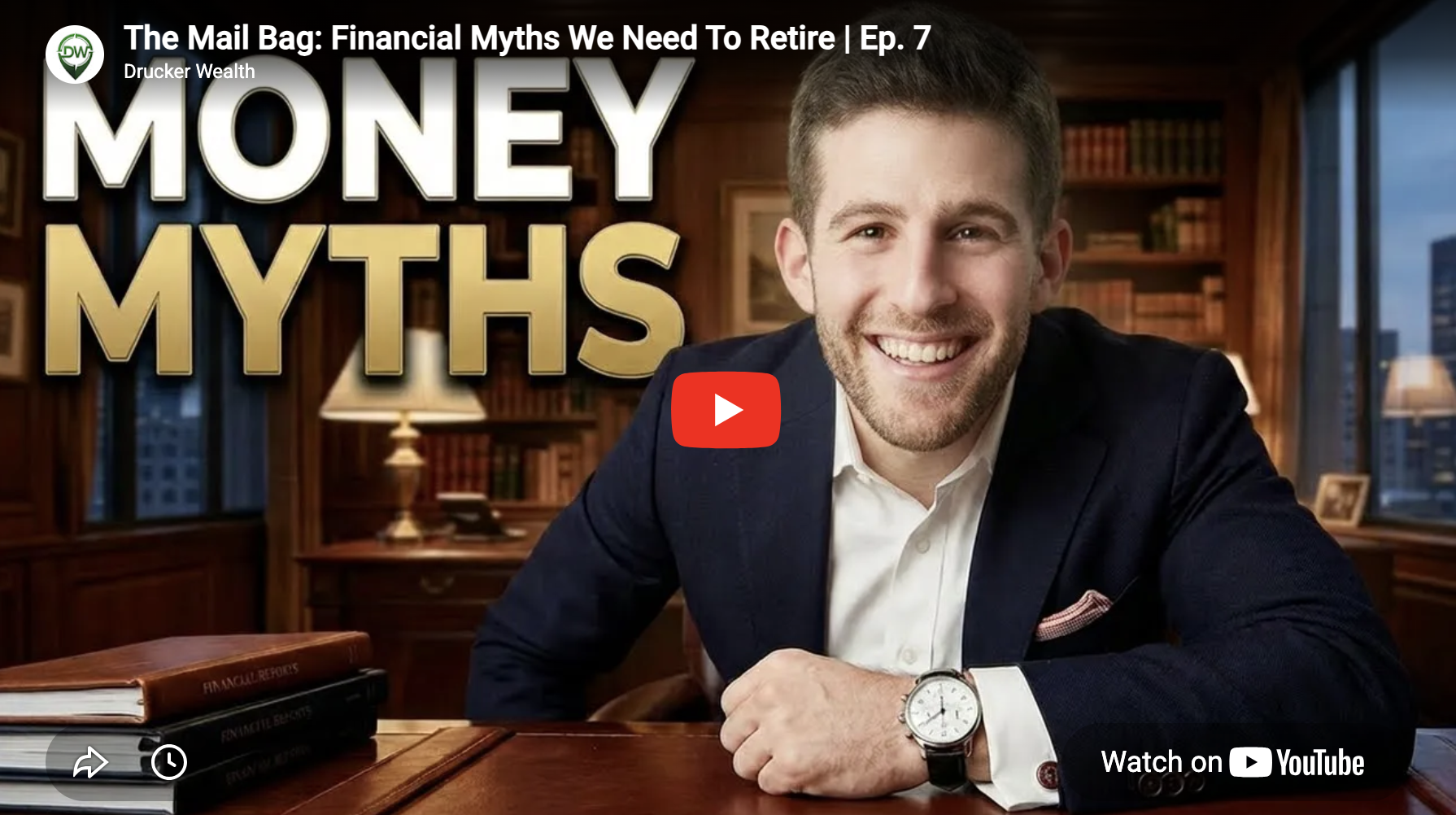
The Mail Bag: Financial Myths We Need To Retire | Ep. 7
Watch the Episode
Episode Summary
Many financial strategies sound smart on the surface, but the real question is whether they actually improve your financial life or simply create more complexity.
In this solo episode of Beyond the First Million, Gideon Drucker breaks down several of the most common financial myths he hears from high-income professionals, including starting a business for tax benefits, buying rental real estate for passive income, and the belief that wealthy people build multiple income streams.
He explains why taxes should never be the primary driver of financial decisions, how to evaluate opportunities through the lens of time, risk, and return, and why focusing on career growth often produces better results than chasing side hustles or financial shortcuts.
The conversation also covers charitable giving strategies, rental property misconceptions, bonus tax myths, and the long-term habits that help high earners build wealth more effectively.
Topics Covered
Why Taxes Should Never Drive Financial Decisions [02:47]
The Problem With Chasing Tax "Hacks" [07:56]
The Seven Income Streams Myth [13:22]
Bonus Tax Myths and Closing Thoughts [14:04]
Resources & Links
Transcript
Below is the full transcript for Episode 7 of Beyond the First Million.
Introduction [00:00]
Welcome to Beyond the First Million. I'm your host, Gideon Drucker.
Last week we spoke about Drucker Wealth as an advisory firm. Today I'm doing a solo podcast in a Bill Simmons mailbag style. I don't know how many of you know or listen to Bill Simmons. I've been reading his mailbag since I was 12 years old. I remember being in middle school, literally not paying attention to what the teacher was saying, and writing what I thought was going to be a genius question for the mailbag. I never got in, but now he does podcast mailbags by himself, and I actually thought that would be a cool idea for this show.
Every month or two, we'll do a Q&A. Any questions that come in as comments below the podcast, or from people reaching out directly, we'll answer them. We'll probably set up an email, have people write in with questions, and those will become my solo excursions.
That's what we're doing today. Obviously, we haven't asked for questions yet, so these are really my own questions for myself. But I'm basing everything we're going to talk about today on actual client questions that come up in prospective client calls.
Before I dive into the content, let me set the stage a little bit. We do what we call Right Fit Calls, a 15- to 20-minute call with any prospective client who's trying to determine whether they want a financial planner, could use help, or would be a good fit for how we work. I've probably had 500 of these calls over the last few years. I still take most of these inbound first calls, so I really get to hear why people reached out, what they're looking for help with, what's keeping them up at night, and what they're thinking about.
As you might imagine, I try to dive a little deeper on these calls. If someone says, "Hey, I'm thinking about buying a first home," I'll ask how they're thinking about it. Have they thought about how much they want to spend? The location? What's driving the decision? I'm always trying to gather a little more information.
In the context of these calls, people will often ask a question or make a comment where, in the back of my mind, I'm thinking, "That's something we're going to have to unpack a little bit." I don't want to say correct, but maybe change the way they're thinking about it. That's what we're going to focus on today.
These are prospective client questions or ideas where I think they've gotten the wrong information, or where there's some kind of financial myth floating around. Before we can provide value or do any real planning work, we need to reset expectations a little bit. We need to get them driving on the right side of the road before we focus on what kind of car they're driving, to continue the analogy.
I also haven't mentioned that we have a second book, How to Avoid HENRY Syndrome: Unlocked. There was a conversation before we started this podcast about whether it was disrespectful to the book to use it as a coaster for my water.
I'm here to tell you: buy the book. It all goes to charity. You can see the charities on our website. Buy it to read, buy it as a coaster, buy it because it has a nice shiny cover. We don't care. It's all good. The money goes to charity either way.
Why Taxes Should Never Drive Financial Decisions [02:47]
What do we want to talk about? A lot of this is going to be about tax. It's not an accident, because I think taxes warp people's minds a little bit. People hate paying taxes so much, and I understand that. I'm not questioning or challenging it. I think we can all spend our tax money better than the federal government can. But I think because we all get so emotionally annoyed by paying taxes, sometimes we're obsessed with saving money on taxes. We'll spend $3 to save $1 in tax and not realize that, in the aggregate, we lost money.
What do I mean by that? I get this question from high-income W-2 families all the time. One spouse is in tech and one is a doctor or an attorney, and they'll say, "Hey, we're thinking about starting a business. We're really interested in saving money on taxes." And I'll say, "Cool, that's great. What's the business idea? How would you generate revenue?" And they'll say, "We're not really sure yet. We just know it's helpful for saving money on taxes." If this sounds crazy to you, cool. It did to me at first as well. The idea that we're going to do something or start a business purely for the tax outcome at the end of it is entirely backwards.
Taxes should never drive the bus. Taxes are a passenger on the bus. They are not the driver. We want to make good financial and investment decisions and then do so in the most tax-efficient way. But if the main driver of any decision you're contemplating is tax, it is the wrong decision. I genuinely feel confident saying that.
The idea of starting a business because, "I can buy a car and use it in my business, and I have all these business expenses," is backwards. If you lose money because the business is not profitable and you have no way of generating revenue, it doesn't matter how much money you're saving in taxes. If you're wasting money, time, energy, accounting help, and adding all this extra complexity to your life just to save a few shekels on tax, when tax wasn't the main issue or concern in the first place, you're not moving the ball forward. Again, it sounds like a crazy question. I've heard it double-digit times. I think part of it is that people think there are tax hacks. Better to be a business owner for taxes? That is objectively true. It is also really difficult to be a business owner.
If you have an idea, a way of making money, a skill set, and you want to work on your own, awesome. By the way, we have a lot of clients who built up expertise in tech and consulting and then decided they wanted to go out on their own. It's a great decision. They realize, "Wow, I'm able to replicate 75% of my income in 25% of the time. I'm happier, I control my schedule, I don't have a boss," and all of it.
So this isn't me saying don't start a business. We've helped plenty of clients start businesses. We've used some of these tax benefits. In terms of retirement savings, you can typically do a little bit more. There are additional deductions. If you have kids, you can include them in certain benefits. There are a lot of advantages.
But it only works if you're actually able to make money in the business itself. Otherwise, you're creating a much bigger problem where one didn't exist before. There's nothing worse than being a business owner when you never really intended to be one. You're stressed about revenue, stressed about clients, and adding another thing to your plate. For the people we're talking about, who already have a lot going on, adding another thing to their plate is usually not the solution.
I'll say the same thing when it comes to charitable giving. We have a lot of clients who are philanthropic. They love giving and supporting the things and people they're passionate about. Sometimes clients bring up charitable giving because of the tax benefit, and I have to say, "Hey, if you want to give to charity, awesome. We love that, and we want to help you get there."
But giving $3 to charity to save $1 in tax still means you have less money at the end of the day. You might get a 30-cent-on-the-dollar tax deduction, but you're still giving away the entire dollar. Again, that's perfectly fine if giving is what you want to do. But it is not a positive cash-flow decision by itself.
Now, if you're going to give to charity anyway, there are more tax-efficient ways to do it. If you plan to give $10,000 a year for five years, you may be better served by putting $50,000 into a donor-advised fund in year one. That doesn't mean the charity gets all the money immediately. The money goes into the donor-advised fund, and then you can allocate it over those five years however you want.
We like to call it "lumpy charitable giving" because you get more of the charitable deduction in one year. Charitable contributions are part of your itemized deductions. If you're giving $10,000 each year and your itemized deductions are only slightly above the standard deduction, you're not really getting the full value of that charitable deduction.
But if you lump it all together in one year and contribute $50,000, now your itemized deductions are significantly higher and you're capturing much more of the deduction. If you set up a donor-advised fund, you can still give to charities over the next five years in whatever cadence you want. It's not like you're getting the deduction now and then giving up flexibility later.
That's probably a whole separate conversation, but my point is that there are always smart and tax-efficient ways to do things. That's the charitable giving example. Starting a business is the same way.
We never want to do things for the tax benefit alone. We want to do things because, from an investment standpoint, we're earning more money as a result of the decision, we're benefiting from a time standpoint, or we're improving our overall situation. Then we want to be as tax-efficient as possible around that decision.
The Problem With Chasing Tax "Hacks" [07:56]
This ties back a little bit to what I was saying before. I want to make sure I hit on everything because I think people focus so much on the tax benefit. Then you have to step back and ask, all right, how much time would that take? How much would that cost? What would the return actually be at the end of the day? Those aren't secondary considerations. Those are the first considerations.
The next part, and this is tied to the broader idea of obsessing about taxes in lieu of the bigger picture, is buying rental real estate. We get asked about it all the time. It can work, and we'll explain when it works best, but you have to look at how it fits into the broader scheme. When our clients are asking about it, or when prospective clients are asking about it, let's set the stage for what their family profile looks like. They're in their early 40s, dual income, both working crazy hours, three kids, not enough time to make dinner half the time, let alone meet with us when they need to. And they're asking, "Hey, should we buy rental properties as a way of generating additional income?"
My first comment is that income right now is not the goal. That is not what we're driving toward. You guys make $600,000 to $700,000 a year. What we care about is compounding your wealth. Income is a part of that, right? There are basically two sides to total return: appreciation, which is capital growth, and income. We don't really care which component is doing the work. That's actually an issue, a little bit, with dividend investing, for example, which we do like for clients at a certain stage, when people become focused only on the income part.
Ultimately, for a 43-year-old, what matters is how much money you're going to have in these accounts at the time you actually need to take money out of them, which means when you're 65 or 70. Generating income when you're 43, when you're not living on that income, don't need that income, and already have substantial income coming in from your day jobs, is not really moving the needle.
I would argue that when people start thinking about generating additional income, there's often something else in the financial plan that's missing, wrong, or bothering them. Maybe they're spending too much and they feel stressed about it. So they think if they just had an extra $2,000 a month coming in, that would solve the problem, when usually there's a bigger issue underneath it. But that's even assuming there is income in the first place.
What we see often is that when we really do the math, somebody has a rental property, they're making mortgage payments, paying interest, covering expenses, and after everything they're netting $300 or $600 a month. The amount of work it takes to manage it compared to the amount of income being generated just doesn't feel like a great trade-off.
There's nothing passive about rental real estate. Most of our clients who have gone through it say after a year or two, "You know what? The juice isn't worth the squeeze." The amount of stuff they have to be involved in, the amount of things they have to deal with, they eventually just want to get rid of it. There's so much extra real-world involvement. And we always talk about risk versus reward in investing. So sure, maybe a rental property generates income. Maybe you sell it one day. But what's the risk?
What's the worst-case scenario? A floor leaks. You can't find tenants. There's an issue with tenants and you can't get them out. There are so many things that can take what was supposed to be a little extra income each month and turn it into a nightmare. Your S&P 500 fund isn't calling you about a mold issue. Your investment portfolio isn't calling you about a leaky faucet. It's not calling you because a tenant won't accept a rent increase. None of those things happen. Again, risk is only relevant in the context of return. What is the upside potential? But if there's not much income, nothing passive about it, and you have to work at it, while there is still a real possibility that things go wrong, even if it's unlikely, you have to think twice about it. Now, it isn't all doom and gloom.
When does rental real estate make sense? It makes sense when people treat it like a business. When they say, "Hey, we have five properties. We run a P&L. We have a management company." At that point you're treating it like a business. You're calculating ROI. You're focused on what it can actually bring you. You need a lot of scale before it really starts to bear fruit. I think the idea that a 43-year-old couple with $2 million in investments is going to buy one rental property and that income is going to materially impact their financial life just doesn't really work like that. If you're worth $100 million and you have a real estate portfolio with 30 buildings that's cranking out income every week, and you have an entire team managing it, sure, it can absolutely be a great vehicle. But that's not relevant or practical for an individual family with $1 million to $5 million that's simply trying to become financially independent in the most efficient, time-efficient way possible. So it can work, but at the scale most people bring it up to us, it usually doesn't make sense. Real estate historically has generated returns somewhere in the 3% to 4% range. The stock market, historically, has been around 10%. Net of inflation, closer to 7%, but let's compare apples to apples: 10% versus 4%. If that's the difference between your rental real estate and your investments, there better be a heck of a lot of income coming in to make up for it. Typically there isn't, especially with higher interest rates. If you're buying a property today and financing it, generating enough income to overcome that return difference is a lot harder at 5%, 6%, or 7% interest rates than it was when rates were 2%, 2.5%, or 3%.
The Seven Income Streams Myth [13:22]
One more idea that's tied to this. This is all about taxes and income. Clients will say, "Hey, I really want to generate another income source. Is there another way that I can make money? I need seven sources of income, right? That's what wealthy people do."
I've never heard that from actual wealthy people. The benefit of what we do is that we literally have hundreds of clients making a lot of money in all different ways. And in my experience, working with high-achieving professionals for a decade now, the people making the most money tend to go really deep. They continue advancing their knowledge base and their skill set in one area.
I don't think it behooves somebody who works in tech and is high up at Google to say, "All right, I'm going to start a restaurant on the side and try to generate passive income from selling food." You know what's easier, more likely to succeed, and probably going to make a bigger difference? If I make $400,000 or $500,000 today, what's the next promotion? What knowledge can I obtain that will take that $400,000 to $700,000 over time? It doesn't happen overnight.
A lot of what I've been talking about, starting a business for tax benefits, rental real estate, trying to start side hustles that are unrelated to your main thing, is all about the quick hit. What we're talking about instead is building your career and going deeper and deeper into your area of expertise.
Again, it doesn't happen overnight, but that's where we find clients in their 40s making $1 million-plus. Every industry and every job has different income potential, of course, but that's the pattern we see over and over again.
That's what I would emphasize: focus less on creating a little extra income on the side and more on asking, "How do I keep my head down, keep building wealth, keep saving more money, and keep growing my career?" That's where we see clients whose income seems to jump out of nowhere, when in reality it came from years of dedicated focus on reaching the top of their specific thing, their industry, their company, and the work that they do.
Bonus Tax Myths and Closing Thoughts [14:04]
All right, as I'm looking through my list here, this is less advice and more just something I hear all the time. Your bonus gets taxed at the same rate as all of your other income. It does not get taxed at a higher rate.
I hear that a lot. Again, this isn't so much a planning idea as it is something that's good to know. I think a lot of times people think their bonus is taxed at a higher rate because when the bonus comes in, sometimes it's taxed at a supplemental withholding rate. So when the bonus arrives, it might look like it's being taxed at a higher rate in the moment.But when it comes time to actually do your taxes, all of your ordinary income gets aggregated together and taxed based on your effective tax rate.
If you have a salary of $300,000, you're at Google, you get RSUs worth $100,000, and a bonus of $200,000, all of that comes together. That's what your effective tax rate is based on. The first tranche of income gets taxed at 10%, then 12%, then 24%, and so on. It's not that the bonus is being taxed at a higher rate. It's that when the bonus comes in, you may be receiving less of it because the withholding rate is higher.
The withholding rate might be a little higher, but it doesn't actually change how much tax you owe at the end of the year. And when we're planning, we try to look at all of it together. What is your salary? What is your bonus? What are your RSUs? Maybe salary comes in biweekly. Maybe the bonus comes annually. Maybe RSUs vest quarterly or semiannually.
Let's build saving strategies that match how the income is actually coming in. Monthly, quarterly, annually, whatever it may be. We want the saving strategy and tax strategy to line up with the way the income is being paid.
That's going to do it for today's episode. Thanks for listening. Again, if you have any questions or anything you're thinking about that might be interesting for us to cover on another episode, let us know. Put your questions in the comments. We'll also get an email set up for the podcast so we can make this thing official and take it to the next level together.Thanks for being with us. We'll see you next week, next Thursday. Have a great rest of your day and a great weekend.
