
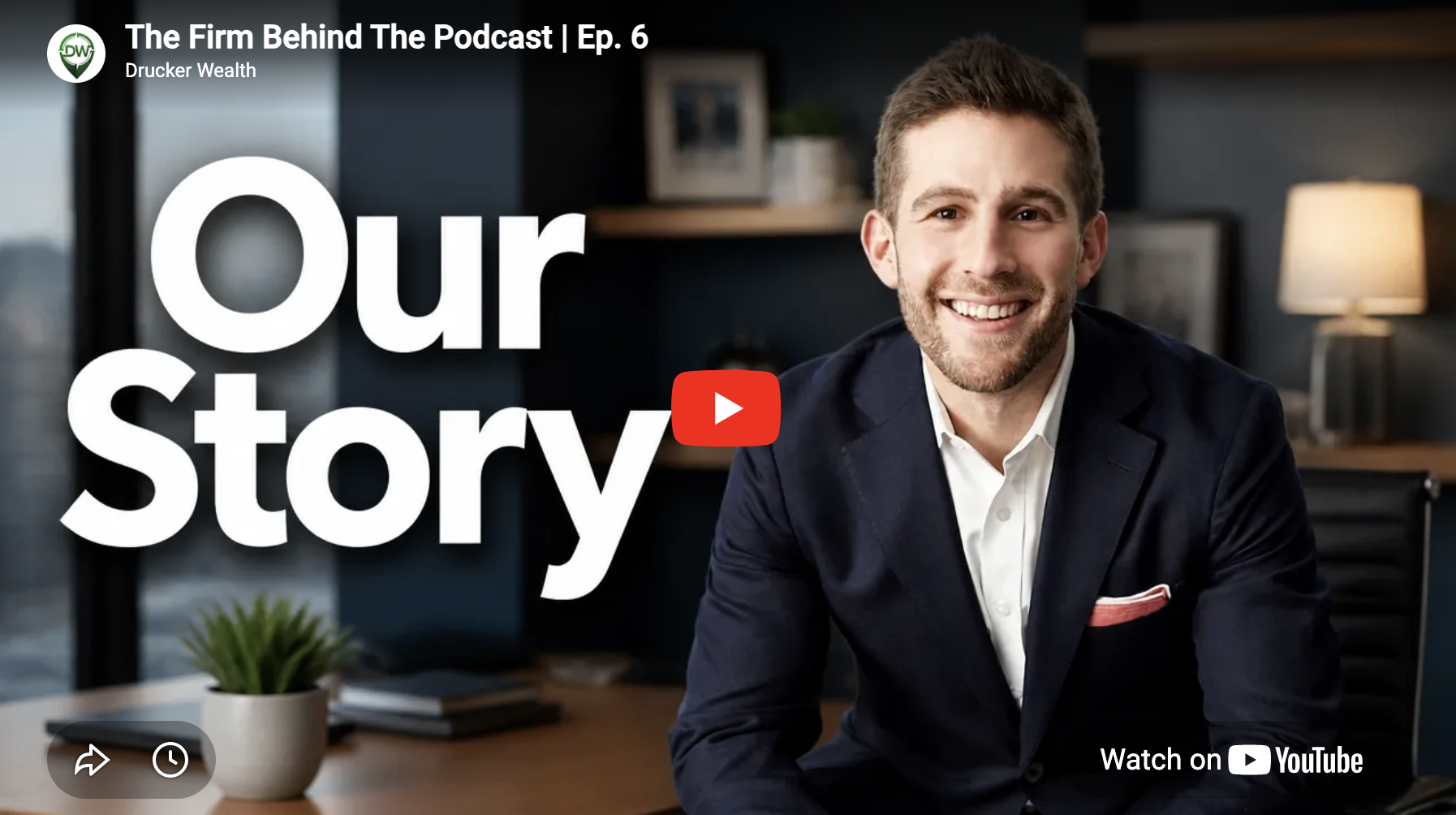
Three Generations of Financial Planning And What We're Building Next | Ep. 6
Watch the Episode
Episode Summary
Choosing a financial advisor involves more than evaluating investment performance. It requires understanding how a firm is structured, how advice is delivered, and whether the team is built to support your broader financial life.
In this episode of Beyond the First Million, Gideon Drucker and Jordan Haines share the story behind Drucker Wealth, including the firm's multi-generational history, who they serve, and why they built an integrated approach that brings tax, estate planning, and investment management together under one roof.
They discuss the role of a financial advisor, the importance of coordinating specialists behind the scenes, and how their Financial Life Plan® process helps clients make confident decisions about their future.
The conversation also explores what makes an ideal client relationship, why not every advisor is the right fit for every family, and how high-income professionals can benefit from a planning-first approach to wealth management.
Topics Covered
The Origins of Drucker Wealth [02:24]
What Makes Drucker Wealth Different? [07:23]
Why Experience and Specialization Matter [11:26]
The Future Vision for Drucker Wealth [14:46]
What It's Like to Work With Drucker Wealth [15:56]
Resources & Links
Transcript
Below is the full transcript for Episode 6 of Beyond the First Million.
Introduction [00:30]
Gideon: Welcome to Beyond the First Million by Drucker Wealth. I'm your host, Gideon Drucker, and this is my co-host, Jordan Haynes. How are you feeling today?
Jordan: I'm feeling great. I'm ready to go.
Gideon: Yeah, we always are. We're prime-time players. Last week, we spoke about home purchase buying, how we think through buying a primary residence, what to spend, what it costs, and how to think through it all. We also spoke about my vendetta with a certain individual in Chappaqua who will remain unnamed. This week is going to be a bit more of a bottleneck episode. You've been listening to this podcast for six weeks. Yes, I'm choosing to assume that everybody listening has gone back and watched or listened to every single episode. It's my podcast, I can pretend what I want.
So, you know a little bit about Drucker Wealth, about us, and about our personal backgrounds, but you don't really know much about how Drucker Wealth operates as a firm. Whether you're looking for a financial planner or never plan to hire an advisor in your life, both are fine. But either way, you're listening to this podcast and hearing us talk about financial planning. So it'd probably be helpful context to know where we're coming from, how we do things as a firm, how we work with clients, heck, even how we charge, and all of that.
We have a newsletter that I think has over 10,000 people now. Most people who read our newsletter are not going to become clients, right? That's just the law of numbers. I consider the whole thing a win. The right people will find us and become long-term clients, and everybody else will get education, learn something new, and hopefully have general good vibes toward Drucker Wealth for no other reason than we're helping them and giving them things to think about. That's how we think about this podcast.
So this episode is going to be Drucker Wealth-specific because, quite frankly, if I were in your shoes, whether I was looking for help or not, I'd want to know a little bit about the people doing the talking and how they approach financial planning on a day-to-day basis. So with that, I'm going to hand it over to my co-host, now the full host of the podcast, Jordan Haynes, and we're going to go back and forth a little bit about the Drucker Wealth story as it exists today.
The Origins of Drucker Wealth [02:24]
Jordan: I will now monologue for 30 minutes. Just kidding.
Okay, I'm going to ask Gideon a couple of questions. My story at Drucker Wealth is a small blip in the grand scheme of things, considering how long Drucker Wealth has been around and everything that has happened along the way. So I'm going to ask Gideon a few questions to better understand the story and give you some context behind where we're at today, how we got here, and where we're going. We're going to follow the story a little bit. Tell me about Drucker Wealth, how it's gotten to where it is today, and then I'll ask you a little bit about your personal story and how you fit into all of that.
Gideon: Yeah, so my grandpa actually started Drucker Wealth. It wasn't called that back then, and at the time it was really just my grandpa and one assistant. But that's where the Drucker Wealth story started. My grandpa started providing financial advice, and then my dad came into the business in 1985. My dad was really the one who took it to the next level. He turned it into a financial planning and investment management-focused firm, which is not what it originally was.
As I said, my grandpa had the hardest job by getting us to first base, because starting from nothing, which is what he did, and getting to that point is the hardest and most impressive part. But my dad is really the one who turned us into a firm. He joined in 1985 and ran the business for 35-plus years. Obviously, I'm condensing the first 50 years of the story a little bit, but I came in at the end of 2016 and officially started in 2017 after I finished my military service in Israel. That's a whole different podcast that I've spoken about before, but maybe we'll save that for another time.
When I joined Drucker Wealth in 2017, we had five or six people, and my dad was really the main advisor. He had built an incredible business, and we had clients who loved us, but it was very advisor-centric. I'm pointing that out because I'm going to come back to it later. When I started, my role was simple. I was young, and it was, "Go out and find people to tell your story to."
I knew I wanted to be an advisor who went out and found clients. The last thing I ever wanted to do, and still don't want to do, is be the son who comes in, keeps the lights on, benefits from everything his parents built, and just tries not to mess it up. I only wanted to be in wealth management if I could bring something to the table. I needed to be able to go out, find my own clients, and do my own thing.
So that's what I started doing. I began working with young professionals because that seemed like the most natural fit. I was in my mid-20s. I was talking to people in their 60s all day, and I kept asking myself, what life experience do I really have to relate to their situation? So I like to say I started the Wealth Builder division, which is a fancy way of saying I wanted to work with younger people where it made more sense for me to be the advisor.
That was really 2017 and 2018. And yes, I wanted to build something of my own and bring on new clients. But it's not lost on me that I had a better start than 99.9% of people who enter this industry. I had a successful mentor, role model, and best friend all wrapped into one person, which is what my dad is. So my attitude has always been that I got an incredible head start, and I'm going to work my ass off to make sure I make the most of it and make it worthwhile.
What really started to change was that I began writing a newsletter. I love to write, and the newsletter started doing pretty well. Eventually, I turned it into a book that came out in 2020.
Jordan: This is book two.
Gideon: This is book two, How to Avoid HENRY Syndrome. I work on one book at a time. That book was really geared toward people in their late 20s and 30s, and it did pretty well. I got a little lucky too. It was during COVID, which obviously wasn't a great time, but from a book-writing standpoint, people were stuck at home, we were already a virtual firm, and people were looking for things to do.
The combination of the book, the newsletter, and the webinars that I still do today had a compounding effect. People all over the country started reaching out for financial guidance. We saw a lot of people in tech, a lot of people in California, Austin, Denver, and New York City. That momentum kept building, and after a year or two I realized we could build this into something bigger than just myself.
There's only so many people I can personally give financial advice to. I wanted to build a team of advisors, like yourself, and figure out how we could grow while providing the same level of service to every client regardless of who their advisor is. I wanted to build that foundation. That all happened in the early 2020s. When I joined, we had six or seven people. By the time this episode airs, we'll be approaching 16 people, and we'll probably be at 20 by the end of the year. Along the way, we built a lot of different things, and I'd say I took over the day-to-day management of Drucker Wealth about three or four years ago.
What Makes Drucker Wealth Different? [07:23]
Jordan: I think what's interesting, and listeners can go back a few episodes to when we talked about financial advisors and finding a financial advisor, is your story and your father's story. One of the things that impressed me most as I joined the team and learned more about that story was that both of you have always been anticipating the future needs of clients. You're growing in your own way, you're modernizing the firm in your own way, and you're evolving Drucker Wealth into what it needs to be. That's been a common theme I've noticed. I'm curious, as it exists today, what do you feel is most unique about Drucker Wealth?
Gideon: My dad always had the attitude of, "What's next?" How can we do things differently? He was the largest advisor at the broker-dealer we were with for, I think, 20 years in a row, which is kind of unheard of. His mindset was always, "How can we make things better? How can we bring in new technology? How can we do things differently?" That's been a core part of Drucker Wealth from day one. We went independent two years ago, so now Drucker Wealth is an independent fiduciary RIA, which basically means we wanted to control every aspect of the client experience. We made that change in February 2024, and it was one of the best things we've ever done.
Jordan: That essentially means, operationally, Drucker Wealth can really do what it wants.
Gideon: Exactly. Part of what's unique about Drucker Wealth goes back to where I started. We're a three-generation business. We have clients, client experiences, and client stories that go back a really long time. We've seen clients at every stage of the journey. On the retirement and income side, many clients have been working with us for 20, 30, even 40 years. That's important because it gives us a foundation. We know what works, we've seen how plans play out, and we've helped people get where they want to go.
At the same time, the Wealth Builder side, which is really the audience we're speaking to, hiring for, and building around, has a bit of a startup feel within a firm that's been around for a long time. We work with high-income, mid-career professionals, and we're very tech-forward. We're not thinking about financial planning the same way it was done in the 1980s or even the 2000s. We're building the firm we want for the next 10, 20, and 30 years.
Jordan: Tell me what you think about this. I'm a first-generation financial advisor. Academically, I understand what generally happens with certain financial behaviors and decisions. Financial planning is really planning for an uncertain future, especially for people who are actively building wealth. One of the things that appealed to me about the team structure, and about you working with your dad, is having 40 years of real-world experience working with actual people and seeing the results of certain decisions play out over time. That's very different from simply looking at an academic forecast. You've actually seen these things happen with real people.
Gideon: Giving advice on paper and giving advice to real people are two completely different things. You can say one thing on paper, but in real life that decision can impact 15 other areas of someone's life that you didn't anticipate.
My first year as an advisor, I must have sat in on 300 meetings with my dad and Katie, the senior advisor on the retirement side, while I was getting my CFP.
Jordan: CFP stands for Certified Financial Planner.
Gideon: I got my CFP while sitting in on all of those meetings, and if you asked me which was more valuable for actually learning how to give financial advice, it's obvious. Hearing, "This is how it's supposed to work on paper," versus hearing what a real client actually says in that situation are two totally different experiences.
We're very specific about who we work with. As we keep saying, we work with high-income, mid-career professionals who are at a specific stage of life and income. We're totally comfortable telling someone that we may not be the right fit if they don't fit that profile. Look at the podcast episodes we've done so far. Home purchases, education planning, those would be pretty dumb podcast topics for someone who exclusively works with clients in their 70s. But for us, those topics speak directly to our audience.
Jordan: I think there are two things I'm hearing that make Drucker Wealth unique. The first is the multi-generational aspect. You, your father, and your grandfather have all built this business, and the experience that comes with that is incredibly valuable. On top of that, all three generations have focused on growth and adaptation.
The second is the focus on a specific type of client. Because your clients are generally in a similar stage of life, you can understand, anticipate, and solve for their needs at a deeper level. What's it like to work for Drucker Wealth?
Building a One-Stop Financial Planning Firm [11:26]
Gideon: The third thing that makes us unique, and that actually ties into the experience of working here, is that we're trying to become, and I think we've already done a pretty good job of becoming, a one-stop shop. We want to have tax preparation and filing in-house. Every advisor should be looking at their clients' tax returns throughout the year, whether they have tax services in-house or not. Tax is such a big part of what we do that if you're not looking at the tax return, there's no way to fully understand the financial picture.
So we're bringing tax in-house, and we have two CPAs on the team right now, both hired within the last year, because we've really committed to figuring out how we're going to provide tax prep and planning to our wealth clients. We have an estate planning specialist in-house, an elite client service team that helps once clients are ready to onboard and move accounts over, and we want to make that process as easy as possible. We want everybody on the team to be able to provide value to the client experience.
To answer from the client standpoint, having a one-stop shop saves so much time, energy, and hassle. Our clients do not have time to deal with four different professionals coming at them from four different directions who don't speak to each other and don't know what the others are doing. Anything that makes their lives easier, more coordinated, and more consolidated is part of our vision. We are also well aware that we're not the highlight of our clients' week. When we meet with them, they're not spending all week thinking, "Oh cool, Jordan's on the calendar. Gideon's on the calendar." They're saying, "I've had eight meetings today. I need to make dinner. I have to get back online later."
We need to make sure we're being efficient with their time and moving things forward in everything we do. Part of that is coordinating with our tax team behind the scenes, working with our estate planner, and bringing everything together at one time instead of making clients bounce around between different professionals. I think that's really cool. There's also only so much one person can do. We can review tax returns, but at the end of the day, we're not tax preparers. We're not looking at things through that lens. Having someone you can call on Slack and say, "Hey, we have this meeting coming up and we just got this tax return back. Can you help me understand if there's anything important we should pull from it?" makes you a better advisor.
It doesn't make you a worse advisor because you rely on a tax expert. It makes you more well-rounded. You have a team you can rely on to provide a better client experience. I can bring a CPA into the meeting and we can have that conversation together.
Jordan: One of the big reasons I joined the team is because I feel like, as a financial advisor, the thing that matters most to me is understanding everything about my clients and then helping the finances make sense around that.
Like you mentioned, having a tax team, an estate planning specialist, or someone who has deep expertise in a specific area of finance is incredibly valuable. Having access to people whose area of expertise is what they eat, sleep, and breathe makes a huge difference. As you look to the future of Drucker Wealth, where do you want to go? Where do you see the business going?
Gideon: Yeah, for right now, I clearly just want to move closer to you because the number of times my chair has subtly drifted toward you, and I'm being told I can't keep doing that...
Jordan: We're trying to focus.
Gideon: I think I'm just really digging you in this conversation. I don't know why. Soon we'll be seven episodes in.
Jordan: We shouldn't swivel. We should really anchor these chairs.
Gideon: Seven episodes in, and I'm like Talladega Nights. It's one of my favorite movies. There's that scene where he's being interviewed and says, "I don't know what to do with my hands," and they keep floating up into the frame. The interviewer pushes them back down, and then they slowly start floating up again.
I've made that reference a thousand times, but it's never been more accurate. I can literally feel myself drifting and gravitating in your direction while we're recording this.
The Future Vision for Drucker Wealth [14:46]
Gideon: Where is Drucker Wealth going? We want to do more of this one-stop-shop approach. I'd say anything with a dollar sign attached to it, we want to be involved in our clients' lives. Tax and estate planning were the big projects of the last two years. What else can we do to make our clients' lives easier and create that one-stop experience?
That might mean getting into the psychology of money as our clients continue growing their wealth. I don't want to say a financial therapist, but I think there will be more situations where we're helping clients think through legacy planning, charitable giving, their kids and grandkids, more on-the-ground budgeting, or simply thinking through spending habits. Having those types of conversations would open up other doors.
We already have an estate planning specialist in-house. I think we'll continue going deeper into that as our clients' net worth grows. Quite frankly, if you're 40 years old with $4 million, back-of-the-napkin math says that by 60 you're going to be approaching estate planning issues. That's not something they need to think about or worry about right now, but if we want to be their financial planner for the next 20 or 30 years, which we do and typically are, then we want to go even deeper down that path. How do we talk about estate taxes? How do we prepare clients for those conversations before they become an issue?
Jordan: Before we close, is there anything else you feel people should know about Drucker Wealth?
What It's Like to Work With Drucker Wealth [15:56]
Gideon: Actually, what does working with Drucker Wealth look like? Everybody starts their engagement with an advisor at Drucker Wealth by doing what we call a Financial Life Plan. It's a two-to-three-month engagement. We charge a flat fee, and we walk through every aspect of your financial world: spending habits, saving habits, your existing investment allocation, retirement projections, tax setup, insurance needs, and more.
We start mapping out your financial priorities and goals. What are you trying to accomplish? What is all of this driving toward? Then we help clients understand what they're doing well, where improvements can be made, and what strategic planning conversations we should be having. At the end of that process, we're giving them an overview, a summary, and recommendations across every aspect of their financial life. That's really phase one of the client relationship.
Phase two, which is where most clients move next, is when they say, "Hey, this is all great. Now we'd like your team's help to actually execute and implement everything you just told us. We want you to hold us accountable year over year." That's when clients become ongoing clients. We have regular review meetings throughout the year, we're holding them accountable, and we're making sure the plan continues moving forward. We think it makes sense for clients to work with a planner on an ongoing basis, especially clients who are as busy and high-income as ours and who value their time as much as they do.
We're not really interested, as a firm, in someone who just wants a project or a one-time plan because we think clients get less value if nobody is helping them implement the plan. If we can't help guide how it's implemented, how much did we really accomplish on the front end? That said, I want clients to make that decision at the end of the process. It's not, "Hey, you're committing to us for life." We want them to go through the planning process first and then decide what's best for them.
So that was probably the most "pitch-like" part of anything we're going to talk about on this podcast, and it wasn't even the intention. But again, you hear how we talk about planning, so it's probably helpful context. People might naturally wonder, "Okay, how do they actually do planning? How do they charge? When they talk about goals and priorities, where does that come into the mix?"
When we talk about home purchases and all these other planning topics, those conversations are part of the Financial Life Plan, and then they become part of the ongoing relationship we establish with clients. I'm not going to get into fees, although they're literally on our website. We don't hide anything. Anyway, that's the Drucker Wealth story today. Thanks so much for joining us. If you have any comments, questions, or topics you'd like us to discuss or expand upon, we're always happy to do that. We really do look at those suggestions as we plan future episodes.
Next time, I'm going to be doing a solo episode about what I say are 11 myths people believe about money. Don't hold me to the number because we'll see how many we actually get through. But we're going to talk about common myths around money, financial planning, and what really matters, and then explain how we think about those topics. Those are some of the most important conversations we have day in and day out, so you won't want to miss that episode. We'll see you next week. Have a great day.
