
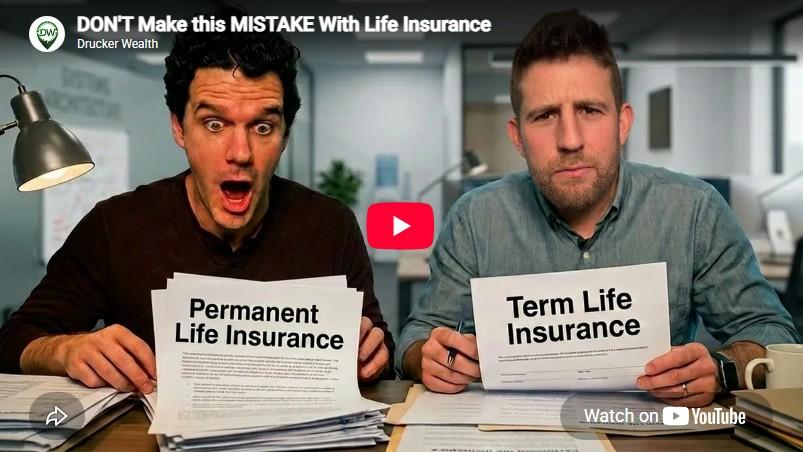
DON'T Make this MISTAKE With Life Insurance | Ep. 9
Watch the Episode
Episode Summary
Nobody wants to talk about life insurance, but that avoidance is exactly why many high earners either have the wrong kind or not enough coverage.
In this episode, Gideon Drucker and Jordan Haines explain why term insurance is usually the right fit for mid-career professionals, how to think through the amount of coverage you actually need, and why a workplace policy often falls short.
They also break down the warning signs of bad insurance advice, including confusing sales language around permanent insurance and “tax-free secrets.”
The conversation closes with a few specific situations where permanent insurance can make sense and why life insurance should first protect your family, income, and financial plan.
Topics Covered
What Life Insurance Actually Does [02:47]
Why Term Insurance Fits Most Families [03:24]
How Much Coverage Do You Really Need? [07:10]
Permanent Insurance vs. Term Insurance [10:38]
Warning Signs of Bad Insurance Advice [13:43]
When Permanent Insurance Actually Makes Sense [16:17]
Resources & Links
Transcript
Below is the full transcript for Episode 9 of Beyond the First Million.
Introduction [00:00]
Gideon: Welcome to today's episode of Beyond the First Million. I'm your host, Gideon Drucker, alongside my much taller colleague, Jordan Haines. Today we're going to be speaking about life insurance, which means we can pretty much say whatever we want the rest of this episode, because everyone has already turned off and moved on to other things. We get it. Nobody wants to talk about life insurance, except life insurance people, and we will get to those people a little bit later in this episode.
It's not about making money, growth in the stock market, retiring early, education, and all the wonderful things that we want to plan for. It's about death. It's about what happens if the absolute worst thing in your life, and in your family's life, happens. But for that exact same reason, because nobody actually wants to talk about it, it's probably the most neglected area of people's finances that we work with. It's the biggest gap they have, and they have never really thought about it. And it's a pretty big one. So that's why we're going to talk about it today.
We have feedback that we should be smiling more. When you're on camera, you should be smiling a lot more than you think you need to, and it would be an interesting episode for us to take that to heart.
Jordan: Smile the whole time.
Gideon: Smiling like crazy people while talking about what happens if you lose your spouse and need life insurance. Hopefully that doesn't come across in the episode, but if that happens, now you know why. I bring up life insurance, and we’re about to get into it. What immediately comes across your mind?
Jordan: Well, first I have to say, like anyone who's recorded anything, you take a few takes, right? You try a few times before you get it right. And Gideon wrote right before this take, “Need to smile more.” We just wanted to comment on it.
Insurance is always an interesting conversation with people. The way I often frame it with our clients is that the worst things that could happen, and the things that would have the greatest impact on your financial success in the future, are dying, becoming disabled, or getting sued. Those are going to be the things that have the biggest impact, but they might not be the most frequent things or the most front and center.
I booked a trip the other day, and any time you book a trip or rent a car, there is always that little insurance option. Those are the types of things we insure a lot. We insure our phones, we insure our pets, and we insure so many things. But for some reason, when it comes to actually insuring our life...
Gideon: And our income.
Jordan: Right. And sometimes, no one wants to talk about it, so we don't do anything about it. It feels so ambiguous, like it probably won't happen.
What Life Insurance Actually Does [02:47]
Gideon: So we're going to dive into the mechanics of how life insurance works. We're doing this one time, so stay with us, enjoy this episode, and make sure you take it to heart. Then, in future episodes, we will move back to more interesting and exciting ways of building growth and playing good offense.
So, at its baseline level, what is life insurance? At its baseline, it's pretty simple. It's death benefit protection. If you pass away, your beneficiaries, most likely your family, your spouse, or your kids, get a payout. Let's say you have a $2 million policy. God forbid you pass away, your family is getting $2 million tax-free. At its core, that's what life insurance is.
Why Term Insurance Fits Most Families [03:24]
Gideon: And there are different types. We're going to start with the one we utilize the most, and the one that is the better fit for most people: term insurance. It is the type you rent. You say, “Hey, you're married, you have three kids, and you get a 10, 20, or 30-year policy. If God forbid something happened to me over this 20-year period, and I have $5 million of death benefit, my family gets $5 million of coverage.” It is typically super inexpensive to get that type of coverage because you're renting it. There's no savings component, and if you outlive the coverage, you don't have any more insurance. So the way we like thinking about term insurance is that it's protecting not for when you die, but if you die. If you pass away prematurely, term insurance is going to protect you.
Who needs term insurance? Young families. You have a mortgage, you have kids that you want to hopefully take care of and send to college one day. It's for protecting the worst-case scenario in the short term. A lot of our clients fit this description exactly. If you're 42 years old, you make $500,000, and you have two kids, you need to make sure that, God forbid, something happens tomorrow or next year, you have enough income coming in via the death benefit payout that can take care of your family for the next 20 to 30 years.
Jordan: Can I ask you a question? I can hear some people in our audience thinking, “But I'm single. I don't have any dependents, and I just heard a lot of examples of people depending on you. When I'm single with no dependents, and not really anyone relying on me, how would I think about life insurance?”
Gideon: Yeah, it's a good question. If somebody would suffer economically because you pass away, that is the giant red flag. You need life insurance. If you're young and you want a family one day, and you plan on people economically depending on you at some point, that can also matter.
And by the way, that doesn't just have to be a spouse or kids. That can be older family members. We have some clients who might be 35, make more money than their parents ever did, and are actually becoming more and more financially responsible for older family members. So it can work in both directions. But even then, term insurance is typically so inexpensive, and it's based on your age and health. The younger you are and the healthier you are, the less expensive it is to get the insurance. And if you think about why, it's because the insurance companies have less chance that they would have to pay out, so it's a lower premium to actually get it.
There are some clients who have asked, “Should I have life insurance?” They're 35 and single, and we say, “Getting a 20 or 30-year inexpensive policy, maybe it's $1,000 a year, that you can get now, lock it in, and not have to worry about five years from now or 10 years from now when you do get married and you do have kids, I don't think that's the worst thing in the world.” And again, for our clients, if you're making $300,000, $500,000, or $700,000, locking in 30 years of coverage for $1,000 or $2,000 a year kind of makes sense. Do you need it at that point? No, but I think it's a good way of weighing the cost and benefit.
Jordan: Low cost, high benefit, might as well, kind of.
Gideon: Yeah, exactly. For term insurance, sure. And again, I'm making that distinction, and then we'll come back to the permanent side of it. That's really how we think about it. We'll get into the exact numbers and how we map out how much you should really have.
But if you think about a 40-year-old family, they need the most amount of term life insurance they're ever going to need right now. And each year, if you think about it, that need hopefully gets a little bit lower. Why? Because right now, you're at the lowest net worth you're going to have. Every year, you're saving, you're investing, and you're compounding wealth. Your kids and your family are the youngest they're ever going to be, so you have more years of taking care of them. But you also have the most years ahead of you that you need to replace your income if something were to happen. So, if you knew at 45 that you were going to be able to make it through your working years, well, now you're basically self-insuring yourself. You're getting your net worth up to where it has grown enough, and you don't have working years you would need to make up for.
Jordan: Gotcha.
How Much Coverage Do You Really Need? [07:10]
Gideon: But right now, whether you're 30, 40, or 50, this is the most you're ever going to need term life insurance because you have the most years ahead of you that you need to protect against. But if we think about the point of life insurance and how it actually works, let's say you have a $2 million policy, and God forbid something happens. Your spouse gets the $2 million policy and comes to us and says, “I need to make this money last. I need to invest it. What should I do?”
The way we would think about that $2 million payout, which is tax-free, is that we need to start generating income to replace your spouse's lost income that they're not earning anymore. So, let's say with $2 million, you were able to earn 4% in income or yield without touching the actual principal, without touching the $2 million itself. That would throw off 4% of $2 million, about $80,000 a year. So you're basically turning that $2 million death benefit into $80,000 to take up your living expenses and make up for the income that's not coming in anymore. Why do we try to leave the principal alone at $2 million? Because we still need to pay for the big things that are coming down the road. You need to pay off your mortgage. You need to make sure education is taken care of for your kids, health costs that come up, and other big planning goals. You want that money for the bigger-ticket things and use the income, the yield that's coming out of that death benefit payout, to replace your income.
Jordan: When we work with a client, we build a financial plan, which is very much like a roadmap for the future. It's how we get to where you want to go. In my mind, life insurance is meant to say, “Hey, we want to continue getting there without disrupting your plan all that much.”
Gideon: Exactly. This is one of those things where if you don't have the right amount of term insurance, and God forbid the worst thing that can happen happens, that's a problem. But if you have $3 million or $5 million, you are emotionally devastated, along with everything that comes with the worst thing happening. But financially, you can say, “Hey, we are still on track to pay for education, retirement, health costs, and all these things that come up in the least financially disruptive way possible.”
The other part I think sometimes people miss, even when we start going into the insurance conversation, is that it's not just that you need to take the income you can generate from the payout to replace your living expenses. It's that if something didn't happen, not only are you having your living expenses, but you're also saving 20% to 30% of your income each year. If something happens and your household income goes from $600,000 to one spouse's income, you may have no capacity to save into your 401(k)s or your investment accounts. We were banking on that in your plan: 20 to 30 years of saving, investing, and growing for the future. So it's taking care of both sides of the ledger.
You can tell from listening that I am passionate about term life insurance for all the reasons that we spoke about. We've heard clients come to us and say, “Well, I have that million-dollar policy through work. I'll probably be fine.” In the back of my mind, I'm thinking, “You make $600,000 a year. A million dollars barely covers two years’ worth of income if God forbid something happened to you.” And even when we do planning, and we talk about probabilities of success, if we were just planning for what's most likely to happen, or the 50% to best-case scenario version of things, most people wouldn't really need a planner. If we just knew that markets were going to go straight up, your income was going to go straight up, and there were going to be no negative changes or things you have to deal with at any point over the next 30 years, most of the clients we work with would be in pretty good shape.
It's because we are trying to figure out, and you said it at the beginning, that the higher your wealth goes, the bigger you want to protect against the calamitous things that could go wrong. How do you protect against those things that can destroy everything else that you spent 10, 20, or 30 years building?
Permanent Insurance vs. Term Insurance [10:38]
Gideon: Permanent insurance is the type of insurance that you own, not rent. Typically, there is a savings component that comes along with the death benefit protection, and it's a lot more expensive because there is that savings component and because you have it as long as you pay the premiums for the rest of your life. So, if you live until you're 70, 80, or 100, you have that life insurance, provided that you're paying each year. So it's a lot more expensive. We'll talk about use cases, but before we even get there, and again, most of the time, 95% of the time, term insurance makes the most sense for most people.
Most of what we do is dealing with protecting against the worst-case scenario. But the starting point to the insurance conversation is not what type of insurance or what company. It's none of that. It's how much death benefit protection do I and my spouse need? Or, if I'm single, do my older family members who are depending on me need protection? Is it $1 million, $3 million, or $10 million? Then you figure out the most cost-effective way of getting there.
So, if somebody needs, like most of our clients, $5 million of death benefit, and they tried to solve that with permanent insurance, it would cost an arm and a leg. It would make no sense. It wouldn't make sense for cash flow, it would disrupt their investment and growth plan, and it just wouldn't fit what they're trying to do. That's the reason we move to, “All right, now let's talk about how much term insurance,” because we are trying to solve this big need for the lowest possible cost.
Jordan: Yeah, it makes me think, if those listening to this go back and listen to our episode where we talked about simplifying, the whole premise of that conversation was that you have a strategy and you know what everything is doing. Insurance, in particular, is one that we see where a client will have it, and we're like, “I don't know why there are all these riders or all these things going on,” when really the thing that they actually needed it for was, “I need to actually insure myself in case something bad were to happen to me.”
Gideon: Most people who come to us and do have permanent insurance policies cannot explain it. They got it five years ago, seven years ago, and almost to a person, they say, “Yeah, I was sold this.” Not that they're not trying to take responsibility, but it's a very clear and transparent, “Somebody sold me this policy. It sounded good at the time. I have absolutely no idea why I have it.” Sometimes it does make sense, and sometimes it doesn't. But my biggest annoyance when these people have it is that they have this permanent insurance policy that they didn't really need, but they don't have term insurance. So an insurance agent looked at them and said, “This is really the best thing that you could have. $3 million or $5 million of term insurance? We're going to ignore that entirely. And here's $400,000 of permanent insurance as a savings component, and sure, we'll do all these other things, allegedly.”
So not only did they sell you things you don't really need, they didn't get you the thing that you actually have. That's not an accident. But most permanent insurance means more money to licensed agents, more money clients are putting into it, so they get a larger commission. Nobody could really run a life insurance business only doing term insurance. And as a result, in both directions, the agent or advisor and the client both kind of get to this point where they don't really want to talk about term insurance.
Jordan: And that's not to say that all agents are bad, right?
Gideon: Of course. We've worked in the past with insurance agents who do an incredible job. But everybody should just know, if term insurance isn't being spoken about, here's what's going on.
Warning Signs of Bad Insurance Advice [13:43]
Gideon: Now, how do you know if you're dealing with a bad agent? If they use language, and I'm smiling because I've seen this on LinkedIn, like, “Be your own bank,” “Do what the rich people do,” “The rich person's Roth IRA,” or anything that is a tax-free secret across any domain, insurance, real estate, anything that is a tax secret. The tax code is public. There are no secrets in the tax code. There are ways of strategizing and doing things a little bit better, but if anyone is trying to use language where they're obfuscating so much about the thing that they're actually talking about, and if they need to come up with nine other examples of what this thing is they're actually doing for you, I would go in a different direction. Run for the hills.
If somebody's bringing up permanent life insurance really early in a conversation, that is a good sign that you're speaking to a life insurance agent, not a financial planner who is trying to solve a need. If you're talking about that before cash flow, education funding, retirement projections, and how much actual coverage you need, and it's just, “Well, this is a great way to save for retirement and have life insurance,” you're going in the wrong direction.
Part of that second point is if you're speaking to somebody who is only licensed to sell and deal with life insurance, you could be licensed to sell life insurance and call yourself a financial advisor. Anybody can call themselves a financial advisor. It's not a designation. It's not a license. You might think they can also manage investments and do financial planning, but those are different designations. If the only thing a person can do is sell you life insurance, and they are legally not allowed to talk about investments and planning, guess what they're going to bring to you? What is the only thing that they can address and solve for?
Jordan: Insurance.
Gideon: Insurance.
Jordan: As you're talking, I'm thinking, in my experience working with people, talking about life insurance isn't the most fun topic. That's how we started this episode. Oftentimes, we don't talk about it until after we've done a lot of the initial work, like, how much do you actually need?
We can't determine how much life insurance you actually need until we know what's important to you. What are your goals, your cash flow, your income? What does your future look like? Only once we understand that can we say, “This is actually how much we think you should apply for.” If someone's flipping that and saying you need insurance before ever understanding those things, well, they're not actually looking at what's in your best interest.
Gideon: Especially if they're talking about the permanent type. We can look at a client, and we typically don't talk about it until two to three months in. It's really the last thing we do as part of that initial plan. But term insurance, you can look into it and say, “Hey, you need X amount of coverage, and it will cost you this.” It's a very binary conversation and decision.
Jordan: And I'm sure you'll get at this too, but permanent insurance exists for a reason. It solves its own problem. I think what you're saying is that for the vast majority of people who are building wealth and want to protect against their life, term insurance just makes a lot of sense for them.
When Permanent Insurance Actually Makes Sense [16:17]
Gideon: But I would say there are really three use cases for when permanent insurance makes sense. All of them involve understanding that you are buying life insurance. Permanent insurance makes sense when you have an economic need and you want coverage for the rest of your life.
So, what's the first example? Somebody who is really motivated by legacy planning. We have a client we just worked with, and in every meeting, one of the spouses mentioned that they really want to take care of their kids no matter when they pass away. She's nervous about the future and what the economy is going to look like down the road. In every meeting, she said, “No matter when we pass away, I want to make sure I'm leaving something to my kids.”
As she said, “I started with nothing. We kind of built, and we would like to make it a little bit easier for our kids. We'd like to leave some money behind. That's really important to us.” So we are talking about permanent life insurance. They have three kids, and from what we're talking about, it would be $3 million of permanent coverage, a million each for the kids.
Part of it, too, is they want the freedom to spend down their retirement assets and not worry about, “Are we leaving anything behind for our kids?” My dad hears a lot from retired clients where, believe it or not, sometimes people get to retirement and they're almost a little nervous to spend down their assets. They are like, “Well, we've always dreamed of leaving money behind for our children or for our grandkids. Legacy planning is important, and if we spend down all of our money, we're not going to be able to.” Buying permanent life insurance protects against that. It's driven by them, not by us. It's not important to us that you leave a legacy to your kids or to your grandkids. It is important if that's your goal.
The second is leverage. I'll use my dad in this. He's financially independent, and we spoke about that. His viewpoint on insurance has always been, if he can spend $1 today to provide $4 tax-free to his kids and grandkids, why wouldn't he do that? It's leverage. He's turning money today that he's not going to use into a lot more money down the road that can benefit his family, charities, and everything he wants to do.
So, it's almost this weird thing. I think too often permanent insurance is spoken about with people too early, when they aren't at the level of wealth where it really makes sense. Permanent life insurance typically works best, if it makes sense at all, for higher-net-worth people, where there is some leverage they are trying to create. They don't need the assets, and they're trying to set themselves up.
Another example is somebody who is 75 and gets their RMDs. Once you turn a certain age, 72 and a half, you have to start taking money out of your IRAs. Basically, it's the government's way of saying, “You haven't paid taxes on any of this money yet. You've deferred taxes long enough.” Some clients will say, “Well, I don't need this money.” They might say, “Let's use some of these distributions that I'm not going to use to target and turn $1 today, that's taxable, into $4 tax-free.”
And that's the last scenario of when it makes sense. If you have an estate tax issue, if you're at a level of wealth that, right now, is approaching $30 million, then again, it doesn't affect a lot of people, or most people listening to this. But if you're above that level of assets, you could set up a permanent life insurance policy and put it into a trust. It's called an ILIT, an irrevocable life insurance trust. You are putting the permanent policy into the trust and getting it out of your taxable estate. That is a use case.
The takeaway of explaining those three use cases is that it's pretty specific. It is not just that you need another asset. It is that you are trying to solve for leverage, legacy, or estate planning. Other than that, term insurance, load up on it. It's inexpensive. You're protecting your family.
And the last point on term insurance I'll make is that you can convert term insurance into the permanent type at any point throughout the policy experience. So, if you get a 20-year policy, maybe you want permanent insurance 10 years or 15 years from now. Who knows? We don't know what the future holds. You're able to convert it without having to go through additional underwriting, meaning if maybe you're not healthy enough in 10 or 15 years to get the coverage on its own, because you locked in this inexpensive term coverage, you can get that permanent coverage without worrying about your health later on. So it just gives you flexibility.
That is another reason term insurance is inexpensive and flexible. You're protecting your family. And then you and we never have to talk about life insurance again. That's really how we frame it to clients: “Hey, we're going to get this $5 million policy. You've done your job. You've protected your family, and we can talk about everything else because we have solved this catastrophic potential loss. Now we get to build the plan in the ways that people like talking about.”
Jordan: Yeah. My big takeaway from this conversation is that life insurance is to insure your life. That's the thing it's doing for you. When you start to conflate that, particularly with permanent insurance, it's easy to do this, where we start to think, “Oh, this is actually my primary wealth-building tool,” or it's a hedge against taxes, or things like that.
We want you to think about life insurance as being there to insure your life. Maybe there are other use cases where you want to create a legacy or plan for what happens after you die, but that's the point of life insurance.
Gideon: Exactly. There are just a lot of life insurance agents, and it's the Wild West out there with what they can talk about with IULs and the market. It's craziness, what's out there. So this whole episode is meant to protect against that type of permanent insurance conversation that's absolutely ridiculous.
I don't even want to tell people what I'm talking about, because then the algorithm is going to give you nothing but that, which is basically what my feed is. And nobody has ever won an argument on social media, so I refrain from engaging. But you're listening to this, and I'm doing that for you.
So that's all we've got on the life insurance front. We hope you enjoyed, if that's the right word, learned something, felt educated, and can have this conversation in a better way moving forward. So with that, we'll see you next week, and have a wonderful rest of your week.
